

Over Half of Pipeline Loss Comes From This One Process Gap

Sales Process Assessment & Audit - Air Marketing, Sales Specialists in the UK

Sales leaders often assume pipeline loss comes down to objections, budget, competition, or shaky follow-up. Those factors play a role – but the data points somewhere far more fundamental.

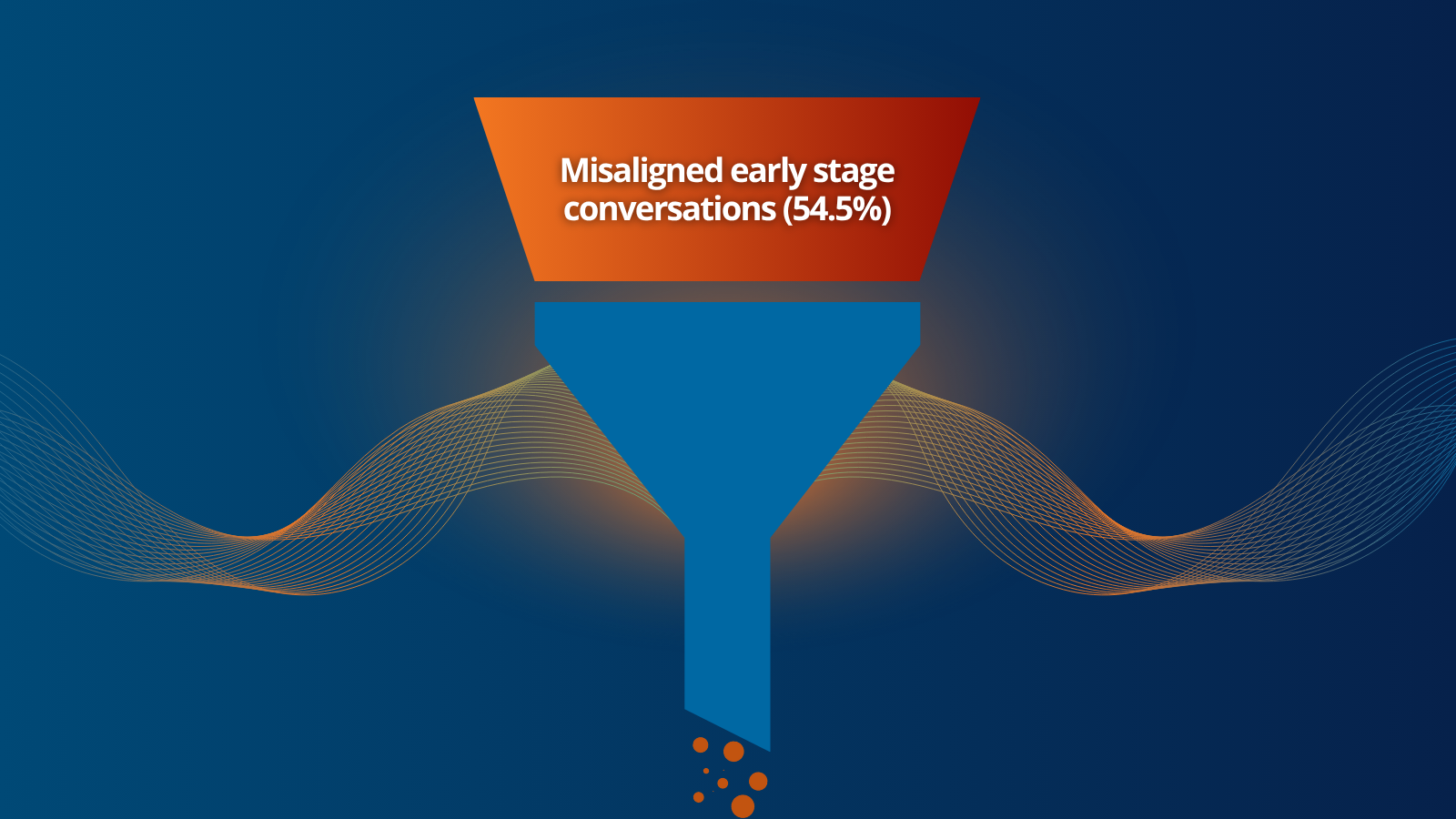
Research shows that in 54.5% of deals*, there is a misalignment between buyer and seller on the core problem that needs solving.

Not poor product knowledge. Not bad proposals. Not inadequate closing technique. The real damage starts in the very first meaningful conversation.

The consequence? When you miss the real problem in discovery, everything downstream becomes harder: qualification, proposal, negotiation, forecasting, and renewal.

Misalignment begins earlier than you think

When sellers and buyers aren’t aligned on the problem, everything downstream loses precision:

  • Qualification becomes subjective and driven by “gut feel” rather than clear criteria.
  • Messaging becomes generic, because the real commercial pain isn’t fully understood.
  • Proposals miss the true decision drivers, so deals slow down or stall.
  • Forecasting becomes skewed, and a high percentage of deals drift into “no decision”.

This isn’t a skills issue. It’s a process issue.

Why this process gap exists

In our work with sales teams, we see three common causes.

1. Discovery isn’t clearly defined in the process

Teams assume discovery is happening because calls are happening. But without a shared structure, the quality varies wildly.

2. Reps mistake rapport for qualification

Conversations feel “good”, so opportunities get progressed — despite vague commercial impact or urgency.

3. Leaders mirror their top performer – and assume everyone else does too

The rest of the team rarely replicates the same discipline, resulting in inconsistency disguised as pipeline.

This is why your pipeline feels unpredictable

If early-stage conversations lack clarity, later-stage accuracy becomes impossible.

  • Your pipeline looks full, but a significant percentage isn’t genuinely qualified.
  • Forecasts lean towards optimism because deals appear more progressed than they are.
  • Deals seem to “drop out” suddenly when they were never truly aligned in the first place.

A structured review separates a pipeline that looks healthy from one that truly converts.

Fixing the process gap that loses half your deals

A proper assessment of your sales process reveals where discovery is breaking down. A robust review should examine:

  • Whether discovery is consistent across the team — not just your highest performers.
  • Whether you uncover the real business problem, not surface-level needs.
  • Whether progression criteria create clarity — or add noise.
  • Whether your qualification model helps or hinders prioritisation.
  • Where real behaviours differ from your documented process — and why.

When teams fix this one structural gap, conversion lifts across the entire funnel — not through new tools but because every deal starts with clarity.

*Source: Corporate Visions – Reality Gap Study indicating that in 54.5% of deals, buyers and sellers are misaligned on the core problem to be solved.

Is Now the Right Time to Review Your Sales Process?

Sales teams are under pressure to deliver predictable revenue. Yet in many organisations, results still hinge on individuals rather than systems. If momentum is carrying you further than method, it may be time to assess whether your sales process is built for the market you sell to today.


Here are ten triggers to help you self-qualify whether a sales process review should be on your agenda.

  1. Deals are taking longer to close

    Sales cycles are stretching out even though your opportunity mix hasn’t changed. That often points to unclear qualification, poor deal control or weak next-step management – all process issues.

  2. Forecasts feel more like guesswork than strategy

    If you’re relying on gut feel or last-minute spreadsheet updates, your pipeline data isn’t giving reliable visibility. A clear, consistent process drives forecasting accuracy and decision-making confidence.

  3. Your new hires take too long to ramp up

    When success depends on individual experience rather than a repeatable framework, onboarding becomes slow and inconsistent. A well-defined structure helps new reps perform faster and more predictably.

  4. Sales and marketing aren’t telling the same story

    If outbound says one thing, your website says another, and content doesn’t match either, prospects get confused and conversion suffers. Misalignment is usually a process gap, not a comms problem.

  5. Your CRM is full of noise

    Duplicates, deals with no next step, or opportunities marked “open” for months are classic red flags. When reps stop trusting the data, the system stops being useful – and leadership loses visibility.

  6. You’re hearing “no decision” more than “no thanks”

    Quiet prospects often signal a process that doesn’t guide clear next steps or reinforce urgency. Strong processes create momentum; weak ones stall it.

  7. Top performers succeed despite the process

    If results come from individual brilliance, not team-wide consistency, your system isn’t doing enough of the heavy lifting. A strong process should elevate everyone.

  8. You’ve added more tools… but things haven’t got faster

    When your stack feels more like a to-do list than a time-saver, tech and process are misaligned. Tools add value when they serve the system – not when they replace it.

  9. You can’t easily explain what “good” looks like

    If definitions of success vary between reps or managers, your process isn’t clear enough to drive consistent performance or meaningful coaching.

  10. You’re relying on experience, not evidence

    If decisions about pipeline, messaging or performance still lean on “what’s always worked”, your process hasn’t evolved with your market. Modern buyers expect modern systems.


Where to start

Reviewing your sales process doesn’t mean starting from scratch. It means identifying what works, where friction lives, and how to create clarity and control across every stage of the buyer journey.

That’s exactly what our Sales Consultancy delivers – auditing your current approach, aligning people, process and technology, and building a framework that improves forecasting, performance management and pipeline visibility.

5 Common Gaps Exposed: Sales Process Audit Insights

Behind every underperforming sales team, there’s usually a broken process. Without structure and clarity, even the best teams struggle to build momentum and scale.

When done properly, a sales process audit reveals the hidden gaps holding back sales performance. From the hundreds of sales process audits we’ve delivered, five clear gaps appear time and time again:


1. Sales Conversations That Lack Structure

Too many salespeople are left to ‘freestyle’ their conversations, particularly in discovery calls. Without structure, messaging drifts, qualification suffers, and deals stall later in the process because the groundwork was never properly laid.

In every sales process audit, we assess how your team runs their conversations: the questions they ask, how they position value, and how well those conversations align with modern buying journeys.


2. No One’s Quite Sure What the Official Process Is

If your process isn’t clearly defined and documented, it doesn’t really exist. All too often, we find sales process documentation is outdated, inconsistent, or simply ignored. That leaves reps interpreting stages differently, pipeline reviews becoming subjective, and deals moving at uneven speeds.

A sales process audit digs into whether your documented process truly reflects what’s happening in real sales conversations – and, importantly, whether your team actually follows it.


3. Collateral That Doesn’t Close Deals

Outdated decks. Generic case studies. Content that speaks more to you than to your buyers. We see it all the time. Even worse, reps often don’t know what resources they have, or they’re forced to create materials on the fly.

We evaluate the quality, accessibility, and effectiveness of your sales collateral. The right tools should equip your team to have more impactful conversations – not hold them back.


4. Data That Can’t Be Trusted

If you can’t trust your data, you can’t forecast, coach, or scale effectively. We frequently uncover reporting issues: pipeline stages that don’t reflect reality, fields left incomplete, or inconsistent logging that makes conversion rates impossible to track accurately.

We dig into whether your data reflects true pipeline health, where deals are being lost, and which behaviours are driving wins. Without reliable data, decision-making is just guesswork.


5. Tech That Slows You Down

Sales technology should be an accelerator – but more often than not, it becomes a drag. We regularly find stacks bloated with overlapping platforms, poor integration, and underused features. The result? Reps spend more time managing systems than selling.

A sales process audit evaluates your stack from top to bottom: adoption, automation, and efficiency. The goal is to streamline and optimise – so tech becomes a genuine enabler of sales success.


Conclusion

If any of these gaps sound familiar, you’re not alone – most organisations experience at least one (if not all five). The difference lies in identifying them early and putting in place the structures, tools, and processes to fix them.

Ready to uncover the gaps in your sales process?

At Air, we specialise in helping businesses optimise sales performance through our Sales Process Audit.

This detailed assessment highlights strengths, uncovers gaps, and identifies opportunities for improvement – helping you increase conversion rates, shorten sales cycles, and drive sustainable growth.