
From Candidate to Closer: How We Build High-Performing Outsourced SDRs

Skilled outsourced SDRs from Air Marketing

An outsourced SDR should not be “ready-made”. They should be built, trained, tested and supported.
In B2B outbound sales, the difference between activity and pipeline is skill. That skill does not appear by accident. It is developed through deliberate recruitment, structured training, coaching, and real-world exposure.

At Air Marketing, we invest heavily in the journey from candidate to closer. Because when we resource outbound campaigns for clients, we are not simply allocating headcount. We are deploying trained, performance-ready professionals who understand how to represent complex brands and generate predictable pipeline.

This is the journey of an Air SDR.


Why Most Outsourced SDR Models Fall Short

A common pattern across growth-stage businesses is this:

  • They need pipeline quickly
  • They hire fast
  • They train lightly
  • They hope for results

The problem is obvious.

Outbound sales is a specialist discipline. It requires commercial intelligence, resilience, structured process, market understanding and conversational skill.

Without proper development:

  • Messaging becomes generic
  • Objections are mishandled
  • Targeting lacks nuance
  • Data is underused
  • Performance fluctuates

Clients feel the impact immediately.

We believe an outsourced SDR should feel like an embedded expert, not a temporary resource. That requires investment before a single call is made.


The Air SDR Journey: From Application to Live Campaign

Our recruitment and onboarding process has evolved over time. What follows is the structure we have refined over the last two years.

It is deliberate. It is performance-led. And it is designed to ensure clients receive skilled outbound sales capability from day one.

1

Stage 1: Application With Voice Note – Testing Communication Early

We begin with a written application and a short voice note.

Why?

Because sales is spoken performance. Tone, clarity, energy and confidence matter.

The voice note gives us insight into communication style, natural presence, commercial maturity, and willingness to step outside comfort zones. We are not looking for perfection. We’re looking for potential and coachability. This ensures we identify candidates with the foundational traits required for outbound sales development.

2

Stage 2: Interview – Assessing Commercial Mindset

Successful applicants are invited to interview with senior leadership and a Team Manager.

This stage focuses on resilience and mindset, curiosity and learning agility, understanding of commercial drivers, and cultural alignment with a target-driven environment.

Outbound performance is not purely technical. It is behavioural. We assess both.

3

Stage 3: Live Roleplay – Proving Sales Instinct

Every candidate completes a mock cold call roleplay with an existing BDE.

This is not theoretical. It tests objection handling, active listening, structure, confidence under pressure, and ability to think in real time.

This step is critical in ensuring we resource clients with SDRs who can operate in real outbound environments.

4

Stage 4: Campaign Allocation Before Day One

Based on roleplay performance and previous experience, we allocate the SDR to their first campaign before they start.

This matters.

Campaign allocation is strategic. We consider sector complexity, target persona seniority, sales cycle length, and messaging sophistication.

This allows induction to be aligned to real client context, not textbook sales.

5

Week 1: Induction, Systems and Sales Foundations

The first week includes full induction, sales process training, systems training, CRM and reporting structure, compliance and data handling, market immersion, and structured call framework training.

By Friday, there is controlled calling exposure.

Why introduce calling early?

Because confidence is built through action, not theory.

6

Week 2: Live Campaign With Ongoing Coaching

In week two, the SDR begins live calling on their allocated campaign.

Alongside this, additional training sessions run, calls are monitored and coached, objections are deconstructed, and messaging is refined.

Performance is not left to chance. It is supported daily.

7

Week 3 Onwards: Scaled Responsibility

If ready, and if campaign need dictates, a second campaign may be allocated.

This decision is based on call quality, meeting quality, confidence, feedback from Team Managers, and early conversion indicators.

8

The 3-Month Probation: Structured Performance Development

Probation lasts three months.

During this time, performance metrics are tracked closely, conversion rates are analysed, coaching is continuous, strengths and development areas are identified, and campaign suitability is reviewed.


What This Means for Clients

When clients engage Air Marketing for outsourced SDR support…

They are not receiving They receive
  • A temporary telemarketer
  • A junior resource without structure
  • A plug-and-play operator
  • A fully trained Sales Development Representative
  • Embedded into their brand and proposition
  • Operating within a proven outbound framework
  • Supported by Team Managers, HR & Operations
  • Backed by performance reporting
  • Continuously coached and optimised

The Commercial Impact of Proper SDR Development

  • Higher quality conversations
  • Stronger meeting conversion rates
  • Better alignment with ICPs
  • More accurate qualification
  • Stronger forecasting confidence
  • Reduced ramp time
  • Lower performance volatility

Outbound is a performance discipline. When skill meets data, activity converts into pipeline.


From Candidate to Closer – And Beyond

The journey does not end at probation.

Ongoing development, campaign evolution and performance refinement continue throughout the lifecycle of every outsourced SDR engagement.

Because we are not simply supplying activity.

We are building revenue engines.

And that begins long before the first call is dialled.


Ready to See What a Properly Built Outsourced SDR Function Looks Like?

If you are evaluating outbound support, ask one simple question:

“How are your SDRs recruited, trained and developed?”

If the answer is vague, so will the results be.

If you would like to understand how our structured SDR model could embed into your growth strategy and build predictable pipeline, we would welcome the conversation.

Complete the form below and we’ll get back to you within one working day.

Talk to an expert at Air Marketing - Trusted Outsourced Sales Agency UK

What Top-Performing Sales Teams Do Differently With Their Process

top performing sales teams - air marketing - outsourced SDRs

What Top-Performing Sales Teams Do Differently With Their Process

By Shaun Weston, Head of Technology & Sales Optimisation at Air Marketing

Every business invests in training, tools, and targets. But the teams that genuinely outperform have something less visible yet far more powerful: an operational discipline around how they sell. It’s quiet, systematic, and often overlooked – but it’s the reason their numbers look the way they do.

Most sales functions believe they have a process, but what they actually have is a collection of habits, preferences, and inherited ways of working. Top-performing teams see it differently. They build a sales process with the same precision an operations team would bring to a factory line – something measurable, repeatable, and continuously improved, not something left to interpretation or personal style.

What the Best Teams Do Differently

1They define a single, clear sales process everyone actually follows

High-performing teams don’t let each salesperson “interpret” the process. They eliminate variability. There’s one process, one language, and one standard for qualification, progression, and forecasting. Consistency makes performance measurable – and therefore optimisable.

2They document every stage of the customer journey

Not in a dusty playbook. Not in someone’s head. The journey is clearly mapped, kept live, and updated as markets evolve. When information is accessible and current, new hires ramp faster and experienced reps operate with fewer assumptions.

3They use qualification frameworks rigorously

Whether it’s MEDDIC, SPICED, or a tailored model, top teams treat qualification as a discipline, not a box-tick. They don’t waste cycles on poor-fit opportunities. They allocate time where the probability of revenue is real.

4They build their sales process around how customers decide

Average teams design processes around internal preference. High-performing teams design around buyer reality. They understand decision journeys, risks, buying committees, budget cycles, and internal politics – and they align their process to it.

5They track pipeline health using leading indicators

Lagging metrics tell you what already happened. The best teams focus on early signals: activity quality, progression speed, conversion ratios, meeting show rates, and deal ageing. They fix issues before the quarter is lost.

6They measure stage-by-stage conversion rates

If you don’t know where deals stall, you can’t improve. Top teams treat the pipeline as an operational system. When a stage leaks, they interrogate the root cause – messaging, skill gaps, ICP mismatch, missing proof points – and they fix it.

7They coach weekly using real calls and real data

Not generic check-ins. Not motivational chatter. Practical coaching based on call reviews, objection analysis, and win/loss insights. The goal is behavioural change that compounds over time.

8They inspect CRM usage – and make it useful

A CRM only feels like a burden when it’s poorly designed. High-performing teams build workflows that genuinely help reps: automated tasks, clean views, and minimal friction. They inspect usage not to police reps, but to ensure data stays accurate enough for operational decisions.

9They align sales and marketing around messaging and handovers

When these functions drift, performance suffers. Top teams maintain tight alignment on ICP definition, campaign themes, qualification standards, lead handling, and feedback loops. Buyers encounter consistent messaging at every stage.

10They automate the repetitive work

Admin isn’t selling. The best teams automate scheduling, reminders, data entry, enrichment, qualification scoring, and follow-up tasks. The aim is straightforward – more selling time without more headcount.

11They refine their process continually

Sales improvement isn’t a quarterly initiative. It’s ongoing operational work. Top teams run short optimisation cycles, test new approaches, update documentation, retrain reps, and enhance workflows. Their process evolves with their market.

The real difference?

High-performing teams don’t assume the process works – they ensure it does. They operate with transparency, discipline, and continuous improvement. They build a revenue engine designed to scale.

Final thought

If your sales results feel inconsistent, the issue rarely sits with individuals. It sits with the process they’re operating inside. The teams that outperform aren’t just better at selling – they’re better at creating the conditions for selling to succeed.

If you’d like support assessing or strengthening your sales process, our team can help you map it, diagnose gaps, and build a more reliable engine for revenue growth.

Over Half of Pipeline Loss Comes From This One Process Gap

Sales Process Assessment & Audit - Air Marketing, Sales Specialists in the UK

Sales leaders often assume pipeline loss comes down to objections, budget, competition, or shaky follow-up. Those factors play a role – but the data points somewhere far more fundamental.

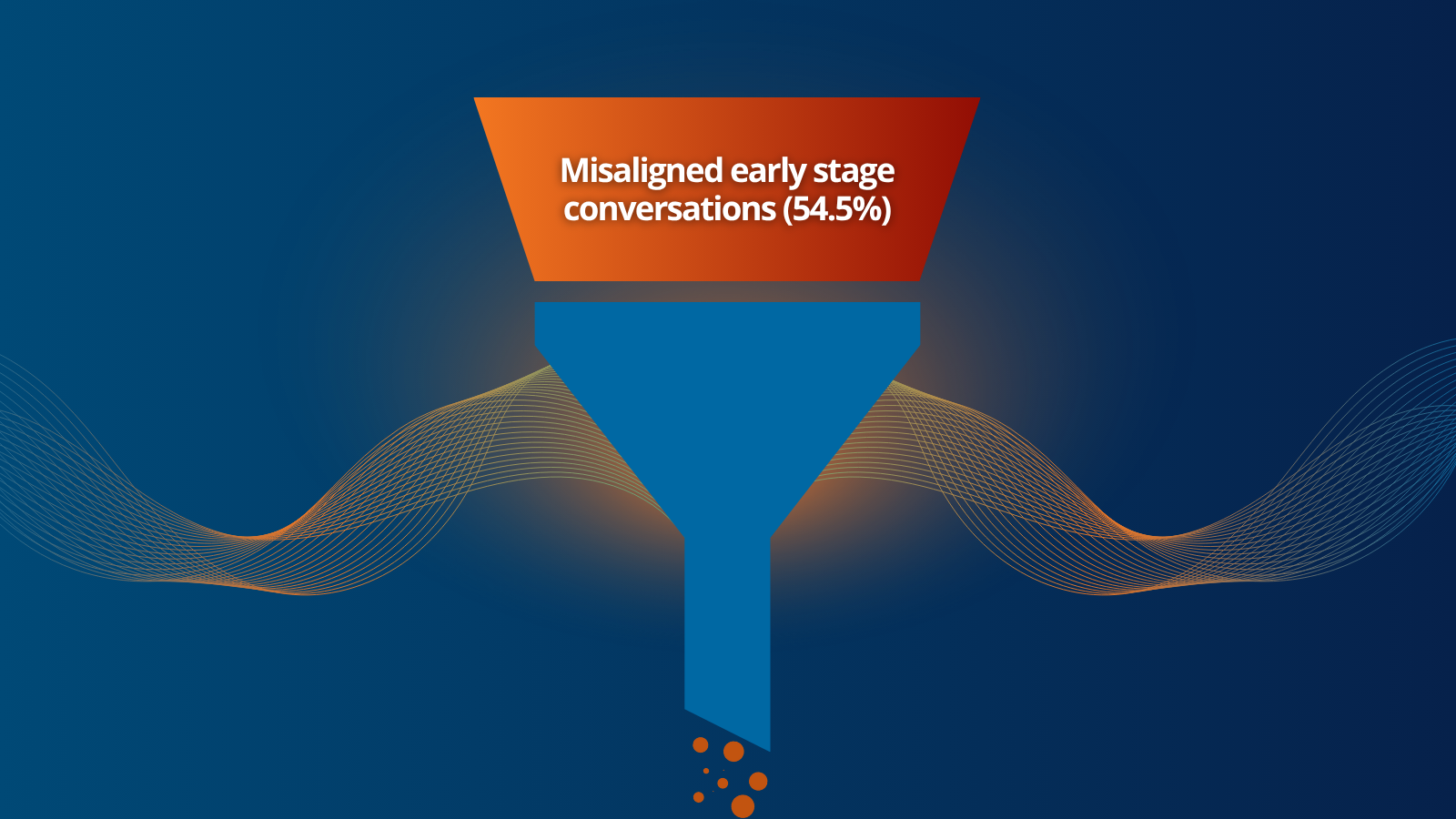
Research shows that in 54.5% of deals*, there is a misalignment between buyer and seller on the core problem that needs solving.

Not poor product knowledge. Not bad proposals. Not inadequate closing technique. The real damage starts in the very first meaningful conversation.

The consequence? When you miss the real problem in discovery, everything downstream becomes harder: qualification, proposal, negotiation, forecasting, and renewal.

Misalignment begins earlier than you think

When sellers and buyers aren’t aligned on the problem, everything downstream loses precision:

  • Qualification becomes subjective and driven by “gut feel” rather than clear criteria.
  • Messaging becomes generic, because the real commercial pain isn’t fully understood.
  • Proposals miss the true decision drivers, so deals slow down or stall.
  • Forecasting becomes skewed, and a high percentage of deals drift into “no decision”.

This isn’t a skills issue. It’s a process issue.

Why this process gap exists

In our work with sales teams, we see three common causes.

1. Discovery isn’t clearly defined in the process

Teams assume discovery is happening because calls are happening. But without a shared structure, the quality varies wildly.

2. Reps mistake rapport for qualification

Conversations feel “good”, so opportunities get progressed — despite vague commercial impact or urgency.

3. Leaders mirror their top performer – and assume everyone else does too

The rest of the team rarely replicates the same discipline, resulting in inconsistency disguised as pipeline.

This is why your pipeline feels unpredictable

If early-stage conversations lack clarity, later-stage accuracy becomes impossible.

  • Your pipeline looks full, but a significant percentage isn’t genuinely qualified.
  • Forecasts lean towards optimism because deals appear more progressed than they are.
  • Deals seem to “drop out” suddenly when they were never truly aligned in the first place.

A structured review separates a pipeline that looks healthy from one that truly converts.

Fixing the process gap that loses half your deals

A proper assessment of your sales process reveals where discovery is breaking down. A robust review should examine:

  • Whether discovery is consistent across the team — not just your highest performers.
  • Whether you uncover the real business problem, not surface-level needs.
  • Whether progression criteria create clarity — or add noise.
  • Whether your qualification model helps or hinders prioritisation.
  • Where real behaviours differ from your documented process — and why.

When teams fix this one structural gap, conversion lifts across the entire funnel — not through new tools but because every deal starts with clarity.

*Source: Corporate Visions – Reality Gap Study indicating that in 54.5% of deals, buyers and sellers are misaligned on the core problem to be solved.

Is Now the Right Time to Review Your Sales Process?

Sales teams are under pressure to deliver predictable revenue. Yet in many organisations, results still hinge on individuals rather than systems. If momentum is carrying you further than method, it may be time to assess whether your sales process is built for the market you sell to today.


Here are ten triggers to help you self-qualify whether a sales process review should be on your agenda.

  1. Deals are taking longer to close

    Sales cycles are stretching out even though your opportunity mix hasn’t changed. That often points to unclear qualification, poor deal control or weak next-step management – all process issues.

  2. Forecasts feel more like guesswork than strategy

    If you’re relying on gut feel or last-minute spreadsheet updates, your pipeline data isn’t giving reliable visibility. A clear, consistent process drives forecasting accuracy and decision-making confidence.

  3. Your new hires take too long to ramp up

    When success depends on individual experience rather than a repeatable framework, onboarding becomes slow and inconsistent. A well-defined structure helps new reps perform faster and more predictably.

  4. Sales and marketing aren’t telling the same story

    If outbound says one thing, your website says another, and content doesn’t match either, prospects get confused and conversion suffers. Misalignment is usually a process gap, not a comms problem.

  5. Your CRM is full of noise

    Duplicates, deals with no next step, or opportunities marked “open” for months are classic red flags. When reps stop trusting the data, the system stops being useful – and leadership loses visibility.

  6. You’re hearing “no decision” more than “no thanks”

    Quiet prospects often signal a process that doesn’t guide clear next steps or reinforce urgency. Strong processes create momentum; weak ones stall it.

  7. Top performers succeed despite the process

    If results come from individual brilliance, not team-wide consistency, your system isn’t doing enough of the heavy lifting. A strong process should elevate everyone.

  8. You’ve added more tools… but things haven’t got faster

    When your stack feels more like a to-do list than a time-saver, tech and process are misaligned. Tools add value when they serve the system – not when they replace it.

  9. You can’t easily explain what “good” looks like

    If definitions of success vary between reps or managers, your process isn’t clear enough to drive consistent performance or meaningful coaching.

  10. You’re relying on experience, not evidence

    If decisions about pipeline, messaging or performance still lean on “what’s always worked”, your process hasn’t evolved with your market. Modern buyers expect modern systems.


Where to start

Reviewing your sales process doesn’t mean starting from scratch. It means identifying what works, where friction lives, and how to create clarity and control across every stage of the buyer journey.

That’s exactly what our Sales Consultancy delivers – auditing your current approach, aligning people, process and technology, and building a framework that improves forecasting, performance management and pipeline visibility.

5 Common Gaps Exposed: Sales Process Audit Insights

Behind every underperforming sales team, there’s usually a broken process. Without structure and clarity, even the best teams struggle to build momentum and scale.

When done properly, a sales process audit reveals the hidden gaps holding back sales performance. From the hundreds of sales process audits we’ve delivered, five clear gaps appear time and time again:


1. Sales Conversations That Lack Structure

Too many salespeople are left to ‘freestyle’ their conversations, particularly in discovery calls. Without structure, messaging drifts, qualification suffers, and deals stall later in the process because the groundwork was never properly laid.

In every sales process audit, we assess how your team runs their conversations: the questions they ask, how they position value, and how well those conversations align with modern buying journeys.


2. No One’s Quite Sure What the Official Process Is

If your process isn’t clearly defined and documented, it doesn’t really exist. All too often, we find sales process documentation is outdated, inconsistent, or simply ignored. That leaves reps interpreting stages differently, pipeline reviews becoming subjective, and deals moving at uneven speeds.

A sales process audit digs into whether your documented process truly reflects what’s happening in real sales conversations – and, importantly, whether your team actually follows it.


3. Collateral That Doesn’t Close Deals

Outdated decks. Generic case studies. Content that speaks more to you than to your buyers. We see it all the time. Even worse, reps often don’t know what resources they have, or they’re forced to create materials on the fly.

We evaluate the quality, accessibility, and effectiveness of your sales collateral. The right tools should equip your team to have more impactful conversations – not hold them back.


4. Data That Can’t Be Trusted

If you can’t trust your data, you can’t forecast, coach, or scale effectively. We frequently uncover reporting issues: pipeline stages that don’t reflect reality, fields left incomplete, or inconsistent logging that makes conversion rates impossible to track accurately.

We dig into whether your data reflects true pipeline health, where deals are being lost, and which behaviours are driving wins. Without reliable data, decision-making is just guesswork.


5. Tech That Slows You Down

Sales technology should be an accelerator – but more often than not, it becomes a drag. We regularly find stacks bloated with overlapping platforms, poor integration, and underused features. The result? Reps spend more time managing systems than selling.

A sales process audit evaluates your stack from top to bottom: adoption, automation, and efficiency. The goal is to streamline and optimise – so tech becomes a genuine enabler of sales success.


Conclusion

If any of these gaps sound familiar, you’re not alone – most organisations experience at least one (if not all five). The difference lies in identifying them early and putting in place the structures, tools, and processes to fix them.

Ready to uncover the gaps in your sales process?

At Air, we specialise in helping businesses optimise sales performance through our Sales Process Audit.

This detailed assessment highlights strengths, uncovers gaps, and identifies opportunities for improvement – helping you increase conversion rates, shorten sales cycles, and drive sustainable growth.