Over Half of Pipeline Loss Comes From This One Process Gap

Sales Process Assessment & Audit - Air Marketing, Sales Specialists in the UK

Sales leaders often assume pipeline loss comes down to objections, budget, competition, or shaky follow-up. Those factors play a role – but the data points somewhere far more fundamental.

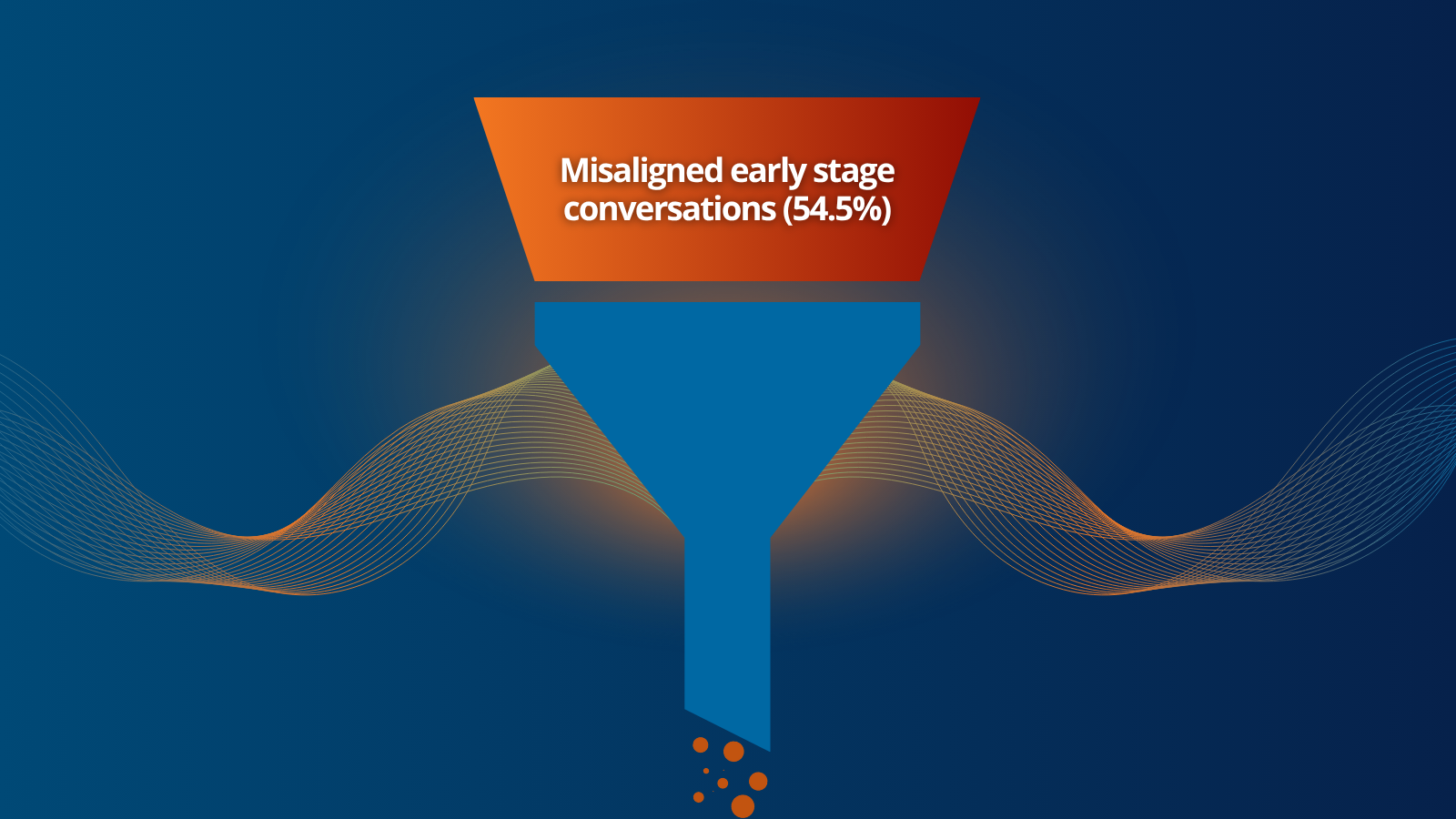
Research shows that in 54.5% of deals*, there is a misalignment between buyer and seller on the core problem that needs solving.

Not poor product knowledge. Not bad proposals. Not inadequate closing technique. The real damage starts in the very first meaningful conversation.

The consequence? When you miss the real problem in discovery, everything downstream becomes harder: qualification, proposal, negotiation, forecasting, and renewal.

Misalignment begins earlier than you think

When sellers and buyers aren’t aligned on the problem, everything downstream loses precision:

  • Qualification becomes subjective and driven by “gut feel” rather than clear criteria.
  • Messaging becomes generic, because the real commercial pain isn’t fully understood.
  • Proposals miss the true decision drivers, so deals slow down or stall.
  • Forecasting becomes skewed, and a high percentage of deals drift into “no decision”.

This isn’t a skills issue. It’s a process issue.

Why this process gap exists

In our work with sales teams, we see three common causes.

1. Discovery isn’t clearly defined in the process

Teams assume discovery is happening because calls are happening. But without a shared structure, the quality varies wildly.

2. Reps mistake rapport for qualification

Conversations feel “good”, so opportunities get progressed — despite vague commercial impact or urgency.

3. Leaders mirror their top performer – and assume everyone else does too

The rest of the team rarely replicates the same discipline, resulting in inconsistency disguised as pipeline.

This is why your pipeline feels unpredictable

If early-stage conversations lack clarity, later-stage accuracy becomes impossible.

  • Your pipeline looks full, but a significant percentage isn’t genuinely qualified.
  • Forecasts lean towards optimism because deals appear more progressed than they are.
  • Deals seem to “drop out” suddenly when they were never truly aligned in the first place.

A structured review separates a pipeline that looks healthy from one that truly converts.

Fixing the process gap that loses half your deals

A proper assessment of your sales process reveals where discovery is breaking down. A robust review should examine:

  • Whether discovery is consistent across the team — not just your highest performers.
  • Whether you uncover the real business problem, not surface-level needs.
  • Whether progression criteria create clarity — or add noise.
  • Whether your qualification model helps or hinders prioritisation.
  • Where real behaviours differ from your documented process — and why.

When teams fix this one structural gap, conversion lifts across the entire funnel — not through new tools but because every deal starts with clarity.

*Source: Corporate Visions – Reality Gap Study indicating that in 54.5% of deals, buyers and sellers are misaligned on the core problem to be solved.

We’re Not a “Bodies on Seats” Agency – And Here’s Why That Matters

Too many outsourced sales providers still sell the same thing: bodies on seats. A quick fix. A headcount number. Someone to make the calls and tick the activity box.

If you’ve worked with that kind of partner, you’ll know what it really means – inconsistent conversations, poor brand representation, and a revolving door of SDRs who never truly understand your business. At Air, we’ve built our reputation on doing the opposite.

The “bodies on seats” model: quantity over quality

In traditional outsourced sales, speed and volume take priority. Providers hire fast, onboard faster, and push people into campaigns before they’re ready.

  • Training is minimal and generic –SDRs are put on the phones with little preparation.
  • Coaching is rareand often replaced by unrealistic KPIs.
  • Support structures are thin,leaving SDRs to struggle without guidance.
  • High turnoverbecomes the norm, causing brand inconsistency and lost momentum.

The result is more than wasted budget – it risks your reputation and drains the energy out of your pipeline.

The Air Approach: placing high-calibre sales talent

We don’t fill seats. We build exceptional salespeople.

  • Rigorous recruitment focused on mindset – resilience, curiosity, and coachability come before experience.
  • Sales Academy training with structured onboarding and continuous development across objection handling, outreach strategy, and client communication.
  • Best-in-class technology powering every campaign – CRM, sequencing, analytics, and AI-driven insight.
  • Wrap-around support from managers, coaches, data specialists, and performance leads – nobody is left to figure it out alone.
Clients don’t just get people – they get a ready-built sales infrastructure designed for consistent performance.

Why this matters to our clients

  • Brand-safe conversations with SDRs who understand your proposition and tone of voice.
  • Faster ramp and higher conversion because capability and coaching are in place from day one.
  • Predictable, scalable outbound that grows with you – not a revolving door of short-term hires.
  • Shared accountability for ROI and reputation, not just activity volume.

Bodies don’t build pipelines. People do.

There’s a world of difference between having someone in a seat and having someone who’s equipped to represent your business, connect with your audience, and drive growth.

At Air, we’re proud to be known for the calibre of our people – because that’s what truly powers results. We don’t do “bodies on seats.” We build confident, capable salespeople who deliver impact from day one.

Diving deeper

A side-by-side look at how Air Marketing compares to a typical lead gen agency – from the structure of the team to the strength of the results.

Air Marketing Typical Lead Gen Agency
Builds revenue engines, not just meetings Measured on pipeline and revenue impact — aligning data, messaging, SDR performance, and conversion strategy for sustainable growth. Books meetings, not outcomes Measures success on activity volume and meetings set, with limited focus on pipeline quality or revenue progression.
A fully built SDR function, with wrap-around support High-calibre SDRs trained through an expert academy, supported by sales leadership, data specialists, and advanced tech to form a complete outbound engine. Supplies ‘an SDR’ or appointment setter Provides individual reps with minimal structure, coaching, or leadership support, leading to inconsistent performance.
Deep industry and target market expertise SDRs matched to industries and markets for sharper, senior-level conversations with defined Ideal Customer Profiles (ICPs). Generic messaging Relies on one-size-fits-all scripts with limited understanding of industry nuances or buyer pain points.
Built by sales leaders who’ve scaled teams Approach shaped by proven experience in building, leading, and scaling high-performing sales teams. Run by telesales managers Operates with a volume-first mindset — prioritising dial count over process, forecasting, and conversion analysis.
Precision cadences Data-driven, message-tested, multi-channel outreach designed to maximise contact rates and conversion performance. Spray-and-pray outreach Executes bulk sequences at scale with limited targeting or optimisation, resulting in poor engagement and conversion.
A plug-and-play partner for sustainable growth Seamless to launch and built to scale — SDR teams embed within your existing sales function to deliver consistent, long-term results. A short-term supplier, not a partner Designed for quick activation but limited scalability — disconnected delivery teams focused on activity rather than sustainable revenue impact.

Ready to see the difference for yourself?

If you want outbound that delivers revenue, not just activity, let’s talk about what a performance-led model could do for your pipeline.