
How Much Does SDR Outsourcing Cost in the UK? A Complete Guide for B2B Businesses

outsourcing sales costs UK - air marketing

For many growing B2B businesses, outbound sales eventually reaches a tipping point. The Founder can no longer manage prospecting alongside everything else. The sales team is focused on closing opportunities. Pipeline becomes inconsistent, and growth targets become harder to achieve.

At that point, many organisations begin exploring SDR outsourcing.

One of the first questions they ask is simple:

How much does SDR outsourcing cost in the UK?

The short answer is that most fully managed outsourced SDR programmes in the UK cost between £6,000 and £12,000+ per month, although lower-cost freelancer and agency options are available.

However, focusing purely on monthly cost can be misleading.

The organisations that achieve the strongest return on investment from outsourced sales development rarely choose a provider based solely on price. Instead, they evaluate the provider’s ability to generate qualified pipeline, create commercial opportunities, and support long-term revenue growth.

The real question is not simply, “How much does SDR outsourcing cost?” It is, “How much does it cost to build predictable pipeline?”
1

What Is SDR Outsourcing?

SDR outsourcing involves partnering with an external provider to manage some or all of your sales development activities.

Typically, this includes:

  • prospect identification
  • data acquisition and enrichment
  • outbound calling
  • email outreach
  • LinkedIn engagement
  • appointment setting
  • lead qualification
  • pipeline generation

Rather than recruiting, onboarding, training, and managing an internal Sales Development Representative, businesses gain access to an established sales function capable of generating new business opportunities on their behalf.

This approach is particularly common amongst growing B2B organisations that want to accelerate pipeline generation without the cost, risk, and management overhead associated with building an internal team.

2

Typical SDR Outsourcing Costs in the UK

Pricing varies significantly across the market.

The cost depends on the type of provider, the level of support included, the complexity of the campaign, and the experience of the sales resource involved.

For businesses evaluating a fully managed outsourced SDR programme, the typical investment is between £6,000 and £12,000+ per month.

Provider Type Typical Monthly Cost
Freelancer SDR £2,000 – £4,000
Small SDR Agency £4,000 – £7,000
Fully Managed Outsourced SDR Programme £6,000 – £12,000+
Enterprise SDR Programme £15,000+

It is important to recognise that these options often represent very different levels of service.

For example, a freelancer may provide outbound outreach activity but little strategic support.

A fully managed SDR programme may include:

  • campaign strategy
  • target market definition
  • data management
  • SDR resource
  • performance management
  • coaching
  • reporting
  • continuous optimisation

Comparing these options purely on monthly cost is similar to comparing a freelance marketer with a fully staffed marketing department. The outputs, support structure, and potential outcomes are fundamentally different.

3

What Influences SDR Outsourcing Costs?

There are several factors that influence the cost of outsourced sales development.

Number of SDR Resources

The most obvious factor is the amount of sales resource allocated to the campaign.

A dedicated SDR working exclusively on your account will naturally cost more than a shared resource working across multiple clients.

Complexity of the Market

Selling into enterprise organisations with multiple stakeholders typically requires more research, personalisation, and strategic engagement than targeting smaller businesses.

The more complex the buying process, the greater the investment required.

Data Requirements

Successful outbound campaigns rely on high-quality data.

Targeting niche sectors, specific job titles, or international markets often requires additional data acquisition and enrichment activity.

Strategic Support

Some providers simply execute activity. Others contribute to the strategy and optimisation that sit behind effective pipeline generation.

  • messaging development
  • market positioning
  • campaign optimisation
  • sales process design
  • performance reviews

The greater the strategic involvement, the greater the investment.

Reporting and Management

Many organisations require visibility over campaign performance, pipeline progression, and return on investment.

Dedicated account management, reporting infrastructure, and ongoing optimisation all contribute to the overall cost of the service.

4

How Much Does an In-House SDR Cost?

One of the biggest mistakes businesses make when evaluating SDR outsourcing is comparing it only against salary.

The reality is that salary represents just one component of building an internal sales development function.

A typical in-house SDR may require:

  • base salary
  • National Insurance contributions
  • pension contributions
  • recruitment fees
  • sales technology
  • CRM licences
  • data platforms
  • training and onboarding
  • sales management time
  • office equipment
  • employee benefits

In addition, there is the cost of ramp time.

Most SDRs require several months before consistently generating qualified pipeline. During that period, businesses are investing in salary, technology, and management before seeing meaningful commercial return.

When all costs are considered, the true investment involved in building an in-house SDR function can be significantly higher than many organisations initially expect.

This is one of the reasons outsourced SDR teams continue to gain popularity amongst growth-focused businesses looking to accelerate pipeline generation without increasing operational complexity.

5

Why Cost-Per-Lead Can Be a Misleading Metric

Another common mistake is evaluating SDR outsourcing through the lens of cost-per-lead alone.

On the surface, this appears logical.

The lower the cost-per-lead, the better the result.

In reality, the picture is far more complex.

A low-cost lead that never progresses beyond an introductory conversation creates little commercial value.

A higher-cost opportunity that converts into revenue can generate a significantly stronger return on investment.

This is why many pay-per-lead models create challenges.

The provider is often incentivised to maximise lead volume. The client is focused on generating qualified opportunities. Those objectives do not always align.

Successful sales development should ultimately be measured by:

  • qualified opportunities
  • pipeline value
  • conversion rates
  • revenue generated
A £50 lead that never progresses is significantly more expensive than a £500 opportunity that converts into revenue.
6

What Are You Actually Paying For?

One of the biggest misconceptions about SDR outsourcing is that you’re paying for a salesperson.

In reality, you’re paying for the infrastructure required to generate predictable pipeline.

Many businesses compare providers based on the monthly fee alone. But that comparison often overlooks the people, systems, processes, and expertise required to make outbound sales successful.

This is where outsourced SDR services can vary significantly.

Some providers offer access to a sales resource. Others provide a complete outbound sales function.

At Air Marketing, the SDR is only one component of the delivery model.

Supporting every campaign is a wider team responsible for strategy, optimisation, performance management, reporting, technology, and operational delivery.

Commercial Oversight

Strategic leadership, financial accountability, and ROI management to ensure campaigns remain aligned to commercial objectives.

Leadership & Coaching

Performance management, call coaching, quality assurance, and regular reviews that help improve sales conversations and campaign performance over time.

Tech & Innovation

Workflow automation, cadence development, technology optimisation, and sales enablement designed to improve efficiency and effectiveness.

Data & Insights

Data analysis, target market intelligence, trend tracking, campaign reporting, and actionable recommendations that support continuous improvement.

HR & Recruitment

Hiring, onboarding, retention, performance management, and culture alignment that would otherwise sit with internal leadership teams.

Campaign Strategy Management

Strategic oversight, campaign optimisation, and a dedicated point of contact responsible for driving performance and accountability.

When evaluating SDR outsourcing costs, businesses should consider the value of this broader support structure rather than comparing providers solely on the number of SDRs supplied.

Because successful outbound sales rarely comes down to having more people making calls.

It comes from having the right strategy, data, coaching, technology, and management supporting them.

7

What Should B2B Businesses Look For in an SDR Outsourcing Partner?

Choosing an SDR provider should involve more than comparing pricing proposals.

The most effective partnerships are built on transparency, accountability, and a shared commitment to commercial outcomes.

Do They Understand Your Market?

Effective sales conversations depend on understanding your buyers, industry, and commercial challenges.

What Support Exists Beyond the SDR?

Ask who is responsible for strategy, coaching, reporting, data, technology, and performance management.

How Transparent Is Their Reporting?

You should have visibility into activity, engagement, meetings, opportunities, and pipeline progression.

How Do They Approach Continuous Improvement?

The strongest providers regularly review results, identify trends, test new approaches, and optimise campaigns based on real-world performance.

Are They Focused on Leads or Revenue?

Lead volume alone tells an incomplete story.

The best providers focus on generating opportunities that contribute to long-term pipeline and revenue growth.

8

Is SDR Outsourcing Worth It?

The answer depends on your organisation’s goals, resources, and stage of growth.

For some businesses, building an internal SDR function is the right choice.

For others, outsourcing offers a faster and more commercially efficient route to pipeline generation.

Rather than spending months recruiting, onboarding, training, and managing new hires, businesses gain access to an established sales development capability.

This can be particularly valuable when:

  • entering new markets
  • launching new products or services
  • accelerating growth plans
  • testing outbound sales for the first time
  • building pipeline without increasing internal headcount

Ultimately, the decision should be based on outcomes rather than delivery models.

The question is not whether the SDR sits inside or outside your organisation.

The question is whether the approach helps create predictable pipeline and sustainable revenue growth.

Final Thought

The cheapest SDR provider is not always the most cost-effective.

Likewise, the most expensive provider is not automatically the best choice.

The organisations that achieve the strongest return on investment typically focus less on the monthly fee and more on the provider’s ability to generate qualified opportunities, build pipeline, and contribute to long-term revenue growth.

When evaluating SDR outsourcing costs, it is important to look beyond the price tag and understand exactly what is included, how success is measured, and what level of support sits behind the sales activity.

In most cases, you’re not simply buying an SDR. You’re investing in the infrastructure required to build predictable pipeline.

If you’re evaluating whether SDR outsourcing is commercially viable for your business, discuss your outbound strategy with our team and explore the options available.

Complete the form below and we’ll get back to you within one working day.

Talk to an expert at Air Marketing - Trusted Outsourced Sales Agency UK

We’re Not a “Bodies on Seats” Agency – And Here’s Why That Matters

Too many outsourced sales providers still sell the same thing: bodies on seats. A quick fix. A headcount number. Someone to make the calls and tick the activity box.

If you’ve worked with that kind of partner, you’ll know what it really means – inconsistent conversations, poor brand representation, and a revolving door of SDRs who never truly understand your business. At Air, we’ve built our reputation on doing the opposite.

The “bodies on seats” model: quantity over quality

In traditional outsourced sales, speed and volume take priority. Providers hire fast, onboard faster, and push people into campaigns before they’re ready.

  • Training is minimal and generic –SDRs are put on the phones with little preparation.
  • Coaching is rareand often replaced by unrealistic KPIs.
  • Support structures are thin,leaving SDRs to struggle without guidance.
  • High turnoverbecomes the norm, causing brand inconsistency and lost momentum.

The result is more than wasted budget – it risks your reputation and drains the energy out of your pipeline.

The Air Approach: placing high-calibre sales talent

We don’t fill seats. We build exceptional salespeople.

  • Rigorous recruitment focused on mindset – resilience, curiosity, and coachability come before experience.
  • Sales Academy training with structured onboarding and continuous development across objection handling, outreach strategy, and client communication.
  • Best-in-class technology powering every campaign – CRM, sequencing, analytics, and AI-driven insight.
  • Wrap-around support from managers, coaches, data specialists, and performance leads – nobody is left to figure it out alone.
Clients don’t just get people – they get a ready-built sales infrastructure designed for consistent performance.

Why this matters to our clients

  • Brand-safe conversations with SDRs who understand your proposition and tone of voice.
  • Faster ramp and higher conversion because capability and coaching are in place from day one.
  • Predictable, scalable outbound that grows with you – not a revolving door of short-term hires.
  • Shared accountability for ROI and reputation, not just activity volume.

Bodies don’t build pipelines. People do.

There’s a world of difference between having someone in a seat and having someone who’s equipped to represent your business, connect with your audience, and drive growth.

At Air, we’re proud to be known for the calibre of our people – because that’s what truly powers results. We don’t do “bodies on seats.” We build confident, capable salespeople who deliver impact from day one.

Diving deeper

A side-by-side look at how Air Marketing compares to a typical lead gen agency – from the structure of the team to the strength of the results.

Air Marketing Typical Lead Gen Agency
Builds revenue engines, not just meetings Measured on pipeline and revenue impact — aligning data, messaging, SDR performance, and conversion strategy for sustainable growth. Books meetings, not outcomes Measures success on activity volume and meetings set, with limited focus on pipeline quality or revenue progression.
A fully built SDR function, with wrap-around support High-calibre SDRs trained through an expert academy, supported by sales leadership, data specialists, and advanced tech to form a complete outbound engine. Supplies ‘an SDR’ or appointment setter Provides individual reps with minimal structure, coaching, or leadership support, leading to inconsistent performance.
Deep industry and target market expertise SDRs matched to industries and markets for sharper, senior-level conversations with defined Ideal Customer Profiles (ICPs). Generic messaging Relies on one-size-fits-all scripts with limited understanding of industry nuances or buyer pain points.
Built by sales leaders who’ve scaled teams Approach shaped by proven experience in building, leading, and scaling high-performing sales teams. Run by telesales managers Operates with a volume-first mindset — prioritising dial count over process, forecasting, and conversion analysis.
Precision cadences Data-driven, message-tested, multi-channel outreach designed to maximise contact rates and conversion performance. Spray-and-pray outreach Executes bulk sequences at scale with limited targeting or optimisation, resulting in poor engagement and conversion.
A plug-and-play partner for sustainable growth Seamless to launch and built to scale — SDR teams embed within your existing sales function to deliver consistent, long-term results. A short-term supplier, not a partner Designed for quick activation but limited scalability — disconnected delivery teams focused on activity rather than sustainable revenue impact.

Ready to see the difference for yourself?

If you want outbound that delivers revenue, not just activity, let’s talk about what a performance-led model could do for your pipeline.

Outbound: The Sales Function That Refuses to Die

Every few years, someone writes its obituary. The market moves. Budgets tighten. A new technology promises shortcuts. And yet, outbound keeps delivering.

It happened in 2020, when remote work and shifting priorities made cold outreach feel tone-deaf. It happened again in 2023, when leaders were told to do more with less. And now, in 2025, AI is the latest silver bullet pointed at SDR teams, hailed as the cheaper, faster, smarter alternative.

Each time, the same story plays out: outbound gets cut first, then rebuilt later. Because when the pipeline slows, every business rediscovers the same truth: you can’t grow predictably without outbound.

Why outbound keeps coming back

On a spreadsheet, cutting SDRs looks tidy. In the real world, it creates a different cost: the cost of silence. Inbound puts you in front of buyers who are already looking. Outbound gets you in front of the ones who should be.

  • Creates net-new conversations with accounts that aren’t coming inbound yet.
  • Brings timeliness – you don’t wait for intent signals; you create them.
  • Builds reach across buying groups where deals are won (or quietly lost).

The problem isn’t outbound – it’s bad outbound

Much of what gets labelled “outbound” is just mass automation. That isn’t strategy, it’s noise. Effective teams treat outbound as a craft.

  • Precise ICP & segmentation over spray-and-pray lists.
  • Human talk tracks that show understanding, not just personalisation tokens.
  • Consistency and coaching that compound into pipeline, not just activity.

AI won’t replace SDRs – it’ll expose weak ones

AI will sharpen research, trigger detection and message drafting. Useful. But the decisive moment is still human: a relevant opener, control of the conversation, confident qualification.

Reality check: Buyers don’t buy the model. They buy the person who makes the problem feel solvable.

What high-performing outbound looks like in 2025

  • Clean, segmented data with role and timing context.
  • Tight talk tracks focused on pain, impact and next step.
  • Phone-first discipline supported by email, social and paid, not replaced by them.
  • Outcome metrics: meetings, opportunities, revenue, not just dials and opens.
Bottom line: Outbound isn’t dying, it’s evolving. Pair disciplined SDRs with smart data and pragmatic coaching, and you get the one thing the board cares about most: predictable pipeline.

Final thought

Every few years, someone will try to retire outbound. The businesses that keep growing don’t argue, they execute. They modernise the function, back their people, and keep the phone ringing.

Why Your AEs Are Failing at Prospecting – And What to Do About It

For many sales leaders, it’s an uncomfortable truth: your Account Executives (AEs) are great at closing deals but terrible at filling their own pipeline.

It’s not that they can’t prospect – it’s that in most organisations, the structure, priorities and culture set them up to fail. The result? A reliance on a handful of inbound leads, sporadic outreach and a dangerously thin pipeline.

Inconsistent prospecting is one of the most common and costly AE prospecting challenges we see. If your team’s success is heavily weighted on closing skills but the top of your funnel is weak, you’re building a revenue engine on a shaky foundation…

…the kind we break down and rebuild in our guide →  How to Fix Your Sales Pipeline Before It’s Too Late

Why AEs Struggle with Prospecting

Let’s get clear on the reasons first – and spoiler alert: it’s rarely just about “lack of effort”.

  • Conflicting priorities: AEs are judged on hitting monthly or quarterly targets, so they naturally focus on late-stage deals that are closest to closing. Prospecting gets pushed down the list until it’s too late.

  • Wrong skill focus: Closing requires a different skill set from opening. AEs who are brilliant negotiators might not have the same persistence, tone and timing needed for cold outreach.

  • Poor data quality: If they don’t have access to clean, segmented and targeted data, prospecting turns into a slow, frustrating slog. Take a look at → How To Increase Qualified B2B Sales Leads for insights on sharpening lead quality and pre-call readiness.

  • No consistent process: Without a structured cadence and clear metrics, prospecting efforts become sporadic and inconsistent.

  • Lack of accountability: If prospecting activity isn’t measured and coached, it becomes invisible – and invisible work rarely gets done.

The Impact on Revenue

When AEs aren’t consistently prospecting, the pipeline becomes dangerously dependent on marketing, referrals or luck. That’s not a strategy – it’s a gamble.

The lag effect is the real killer: a dry pipeline today is the result of prospecting gaps months ago. By the time you notice, the problem is already baked into your next quarter’s numbers.

What to Do About It: Effective Prospecting Strategies for AEs

The solution isn’t to simply tell AEs to “do more outreach”. It’s about creating the right structure, providing the right tools and instilling consistent habits that make prospecting part of the sales culture.

Here’s how to make it happen:

  • Separate responsibilities where possible: If resources allow, split sales into SDRs/BDRs for outbound and AEs for closing. If not, ringfence daily prospecting time that can’t be interrupted.

  • Block dedicated prospecting hours: 1–2 hours each day, protected from internal meetings or other distractions, ensures prospecting doesn’t get sidelined.

  • Create a repeatable cadence: Use a clear, multi-touch process that combines email, phone, LinkedIn and even voice notes to improve connection rates.

  • Lead with relevance: Personalise outreach with industry insights, role-specific challenges or trigger events such as funding rounds, leadership changes or product launches.

  • Follow up relentlessly: Build persistence into the cadence – most prospects need several touchpoints before they respond.

  • Measure activity and outcomes: Track calls, emails, meetings booked and conversion rates. Use this data for coaching, not just reporting.

  • Invest in skills training: Prospecting is different from closing. Equip AEs with tested messaging, objection handling techniques and the confidence to start high-value conversations.

  • Refine through testing: Experiment with subject lines, call openers and value propositions, and double down on what works.

  • Use tech to scale smartly: Sales engagement platforms can automate parts of the process without losing the personal touch, freeing AEs to focus on meaningful interactions.

The Bottom Line

If your AEs are failing at prospecting, it’s not just their problem, it’s a leadership problem. You can either keep asking closers to also be openers (and watch the pipeline yo-yo) or you can focus on managing AE prospecting performance in a way that builds consistency.

That means building a high-performing prospecting process that’s embedded in your sales culture, supported by training, and measured with the same rigour as closing performance.

A strong pipeline isn’t built in the last week of the quarter – it’s built every single day.

Written by: Ricky Hopwood, Head of Business Development at Air Marketing

Need to transform your sales performance?

At Air, we help businesses reignite growth by designing and executing outbound strategies that work in the real world. We uncover where opportunity is being missed — whether that’s in targeting, messaging, cadence or conversion — and build outbound engines that generate consistent, qualified pipeline.

Our approach surfaces what’s holding you back and unlocks faster, more predictable revenue.

Maximising Sales Performance: Should You Go In-House or Outsourced for Training?

It’s not your imagination, sales development is definitely getting harder. Outbound prospecting is certainly getting harder. Doing the same thing, applying the usual techniques, won’t cut it anymore. More than ever, there’s a need to be coaching and training your SDRs regularly, particularly in the early part of their career.

But what’s the best way to train your sales team? Should you have an in-house trainer or send SDRs to external training courses? Here, we’ll look at the pros and cons of in-house and outsourced sales training and enablement.

Benefits of in-house sales training

Awareness of the business: A trainer who works within the business knows the internal values, processes and systems. You can work through real life situations and confidential case studies.

Ongoing support: In-house trainers are able to train and coach consistently, and provide ongoing support. They’re not simply providing a one-off session, never to be seen again.

Accountability: Working in-house, the trainer can hold participants to account and follow up on the training with them. 

Challenges of in-house sales training

Expensive commitment: There’s the ongoing cost of hiring trainers rather than the variable outgoing of paying for external training courses.

Repetition of content: In-house trainers tend to teach the same things again and again. Being ‘in the bubble,’ they’re less exposed to new, external content and ideas. As Albert Einstein wisely pointed out, “Insanity is doing the same thing over and over again and expecting different results.”

Colleagues as fellow students: Training alongside your team mates tends to mean that you’re bringing similar experiences to the table. You’re not learning about different environments, challenges and case studies.

Benefits of outsourced sales training

Experts in their field: External trainers tend to be subject matter specialists. They’re constantly learning and updating their knowledge to pass on to their students.  

Established programs: Outsourced training is generally a one stop shop. Participants follow a program over a set time (e.g. a one day or half day training session). It’s a well-established and prepared program with specific processes.

Diversity of participants: External training providers usually hold sessions for people from different companies. They’ll bring varying levels of knowledge and understanding, and differing experiences. You’ll learn from each other as well as the trainer. 

Challenges of outsourced sales training

Cost of training courses: Outsourced sales training can be a costly option. Some providers charge £5000+ per day, for example.

Lack of accountability: After your training course, you go back to work and carry on. All too often, you drift back to old habits instead of the new ideas that you learned about. Without anyone to hold you to account, it’s easy to stick with what you know.

Finite learning experience: Once your six hour or six week training program ends, that’s the end. There’s no follow up to check your understanding of the topic, to build on it or to see if you’re successfully implementing the new approach. 

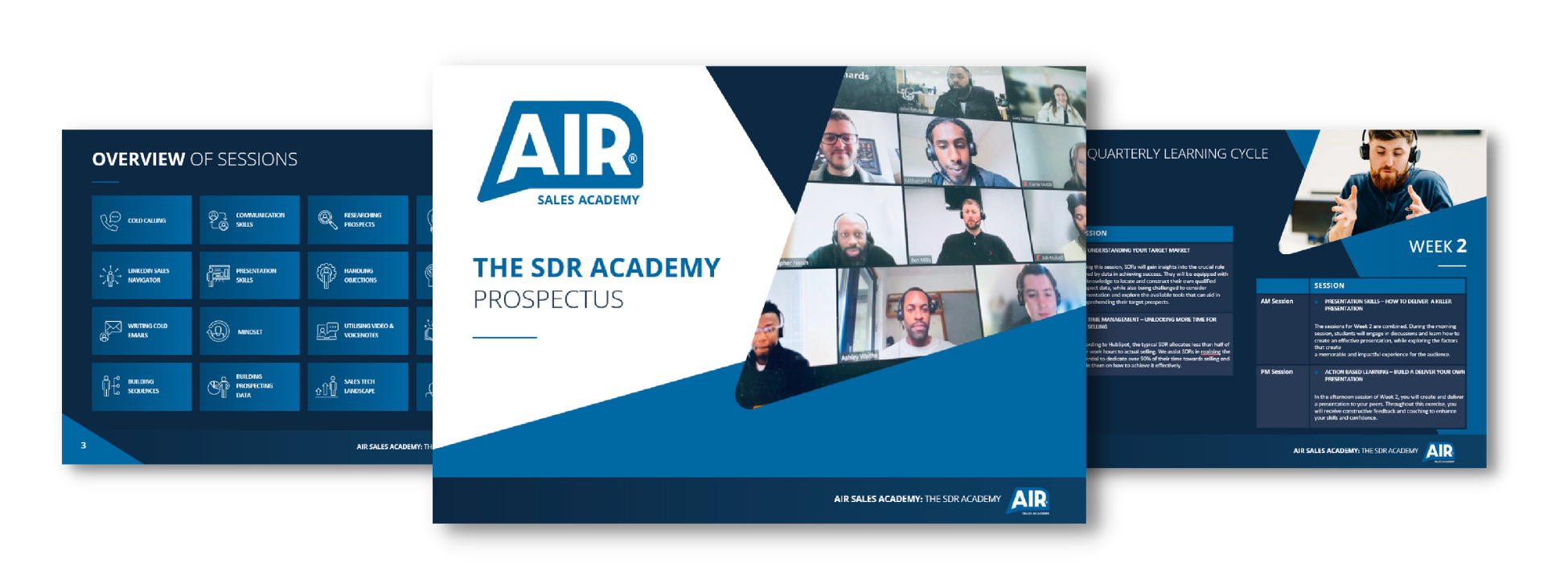
Introducing a different approach – The SDR Academy

We believe The SDR Academy offers something truly different.

The SDR Academy’s unique offering involves both learning new things as well as topping up and refreshing existing knowledge. We hold SDRs accountable for what they’ve learnt with regular sessions every single week. It’s the best of both worlds – a continuous learning journey combined with external expertise and learning from other people with different experiences.

We believe that sales training doesn’t have a beginning and end. You don’t have one session on ‘objection handling’ and then handle every instance perfectly. You don’t attend a session on ‘writing cold emails’ and then compose winning emails every time. You never complete your learning around sales. It’s an evolution; a process of continuous improvement.

The SDR Academy is an ongoing subscription to virtual training sessions. Run in live, virtual rooms, the courses are created and facilitated by leading industry experts. It’s comprehensive, affordable and impactful.

Growing a team of Sales Development Representatives (SDR’s) Vlog #4


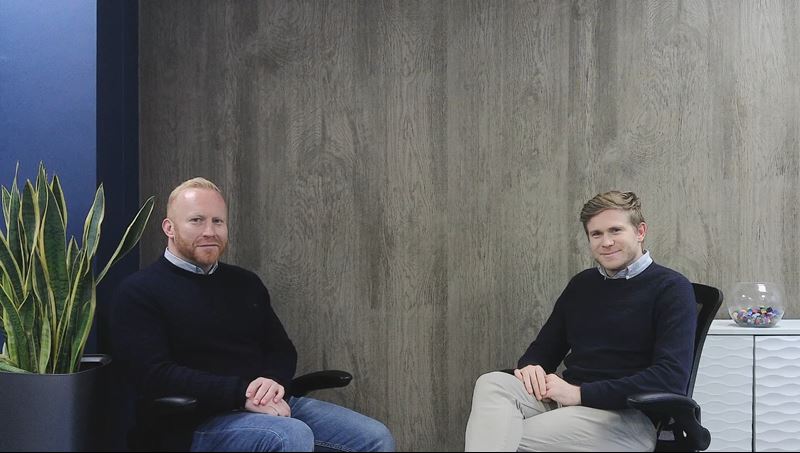
In the fourth instalment of our series we ask the question ‘what are your challenges in growing a team of SDR’s in a tech company?’. Find out the answer in this vlog hosted by our MD, Owen Richards featuring Air’s Sales Director Simon Scott-Nelson.