
Why Businesses Outsource Sales: What Our Research Reveals

Businesses tend to outsource sales when there is a gap between what they want to achieve commercially and what their existing sales operation can realistically deliver.

That gap can appear for many reasons.

Revenue targets increase. A business enters a new market. A new product needs taking to market. The existing sales team reaches capacity. Pipeline becomes inconsistent. Or recruitment simply cannot happen quickly enough to support the growth plan.

The circumstances differ, but the underlying challenge is similar: the business needs greater sales capability, capacity or consistency than it currently has.

To understand what drives organisations towards outsourced sales, Air Marketing reviewed wider evidence on outsourced sales buying behaviour and compared it with the circumstances behind our own client relationships and recent won opportunities.

What emerged was not a picture of businesses outsourcing because they simply needed more people making calls.

Instead, outsourcing becomes particularly relevant when a commercial objective exposes a gap in the existing sales operation, and the business needs a practical way to close it.

Research approach

How was the research carried out?

Our analysis had two parts.

External research

We reviewed publicly available industry reports, sales development benchmarks, consultancy research and market commentary to identify recurring patterns in how organisations evaluate and buy outsourced sales services.

Air client analysis

We compared those patterns with Air Marketing's 15 highest-value client relationships and information captured across a selection of recent won opportunities.

We looked at:

  • Commercial context: What was changing in the organisation when outsourcing was considered.
  • Sales problem: The pipeline or sales outcome the buyer needed to address.
  • Company profile: The industry and company segment involved.
  • Decision-makers: Who led or influenced the buying decision.
  • Alternative options: Whether internal recruitment was considered.
  • Initial engagement: How the relationship was structured at the start.
  • Buyer expectations: What buyers expected the outsourced partner to provide.
  • Growth over time: How the relationship developed after launch.

This is not a market-wide statistical survey, so the findings should be treated as directional rather than representative of every outsourced sales buying decision.

However, the consistency between the wider research and patterns within Air's own client base gives us a useful view of why B2B organisations consider outsourced sales and what they expect from it.

Buying trigger

Why do businesses outsource sales?

The starting point is usually not outsourcing itself.

It is a commercial objective or problem the business needs to address.

That might mean:

  • Market expansion: Entering a new market or territory.
  • New propositions: Launching a new product or service.
  • Higher targets: Responding to increased revenue or pipeline expectations.
  • Capacity constraints: Adding resource around an existing sales team.
  • Inconsistent prospecting: Building a more dependable flow of outbound activity.
  • Lead follow-up: Responding to inbound enquiries or buying signals more consistently.
  • Market testing: Validating a proposition before committing to permanent headcount.
  • Recruitment speed: Reducing the time and risk involved in hiring and ramping SDRs.

In many of these situations, the business has potential customers and a viable proposition. What it lacks is sufficient capacity, infrastructure or consistency to turn that opportunity into pipeline.

The decision to outsource is therefore less about handing sales activity to somebody else and more about addressing a specific gap in the organisation's ability to execute its commercial plan.

Finding one

Commercial change often exposes the sales gap

One of the clearest patterns in the research was the relationship between commercial change and the decision to explore outsourced sales.

Common triggers included funding or private equity investment, new commercial leadership, expansion into new markets, product launches, declining inbound performance and higher revenue targets.

These moments increase what the sales operation is expected to deliver.

But sales capability does not automatically expand at the same speed.

A business might have ambitious growth targets but no dedicated outbound team. It might have an experienced sales function but insufficient prospecting capacity. Or it may need to enter a new market before it has the time or confidence to recruit a permanent team.

That creates a gap between commercial ambition and the organisation's ability to execute against it.

Internal recruitment may ultimately form part of the answer, but defining roles, finding candidates, managing notice periods, onboarding and allowing new hires to learn the market all take time.

Outsourcing offers another route by providing access to salespeople alongside the management, data, technology and delivery processes needed to support them.

The value is therefore not simply additional activity. It is increasing sales capability at a point when the business needs to respond to a commercial opportunity or pressure.

Finding two

The gap looks different across different organisations

There is no single profile of a business that needs outsourced sales.

What changes is the role an outsourced team needs to play within the organisation.

SMEs

Building the capability

Smaller businesses may rely heavily on founder-led selling, referrals and inbound enquiries. Outsourcing becomes relevant when those channels no longer create a predictable enough flow of opportunities and there is no structured outbound function underneath them.

Scale-ups

Moving faster

Investor expectations, ambitious growth plans or new-market expansion can increase pipeline requirements quickly. Outsourcing can help establish a repeatable outbound approach faster than the internal hiring plan can develop.

Mid-market

Protecting consistency

The sales function may already exist, but prospecting becomes inconsistent as Account Executives prioritise live opportunities. SDR turnover and limited management capacity can widen the gap further.

Enterprise

Adding specialist capacity

Larger organisations may use outsourcing for defined execution needs such as regional coverage, a product launch, account-based outreach or the follow-up of demand and intent signals.

Finding three

Buyers often compare outsourcing with recruitment

Across Air's won opportunities, one recurring pattern was that businesses had considered recruiting an SDR before exploring outsourcing.

On the surface, hiring internally can appear to be the more straightforward option.

But an SDR does not operate in isolation.

  • Recruitment: Advertising, candidate sourcing and hiring costs.
  • Employment costs: Salary, commission, employer National Insurance and pension contributions.
  • Technology and data: Equipment, CRM licences, sales tools and prospect data.
  • Training and ramp: Onboarding, development and time before the SDR becomes fully productive.
  • Management: Day-to-day coaching, quality assurance and performance oversight.
  • Performance: Reporting, analysis and continuous optimisation.

This changes the comparison.

Rather than comparing an employee's salary with an outsourced provider's fee, buyers need to compare the complete operating requirements behind each option.

Effective outbound needs people, but it also needs accurate data, clear messaging, appropriate technology, coaching, reporting and continuous improvement.

The question therefore becomes: which model gives the business the capability it needs, within the required timeframe and at a commercially viable cost?

Finding four

Inconsistent execution can create the gap even when the sales team is strong

Not every organisation considering outsourced sales lacks sales expertise.

Some have experienced salespeople, a clearly defined target market and a strong proposition.

The problem is consistency.

Prospecting competes with live opportunities, proposals, account management, internal meetings and closing activity. When those priorities increase, outbound can quickly move down the list.

This creates a stop-start cycle.

Pipeline drops, prospecting activity increases, opportunities begin to appear and attention shifts back towards closing. Several months later, the pipeline gap returns.

This is particularly relevant when Account Executives are expected to generate new opportunities while simultaneously progressing and closing them.

A dedicated SDR function can protect prospecting capacity and maintain a more structured, multi-channel approach to generating qualified conversations while internal salespeople focus on opportunities further through the funnel.

Finding five

Buyers increasingly need capability, not simply headcount

The research suggests that businesses considering outsourced sales are looking beyond additional SDR resource.

If the commercial problem involves execution, adding another person without the infrastructure around them may not solve it.

A well-structured outsourced SDR function can bring together the people required to generate pipeline with the management, data, technology and processes needed to support consistent execution.

Better data

Accurate prospect data, market insight and buying signals help teams identify and prioritise the accounts most likely to be relevant.

Smarter technology

CRM, automation and AI can improve productivity and visibility when they support a clear sales process rather than adding unnecessary complexity.

Experienced people

Skilled SDRs create meaningful conversations, handle objections and represent the client's brand professionally.

Proven delivery

A structured approach gives the organisation greater consistency and clearer visibility into activity, quality and results.

Continuous improvement

Campaigns can be refined using market feedback, call insight and performance data rather than relying on a static approach.

Together, these elements provide something an individual hire cannot create alone: an operating structure designed to support consistent outbound execution and measurable commercial outcomes.

Finding six

Senior commercial leaders tend to make the decision

Air's client analysis found that outsourced sales decisions are generally led or influenced by people directly accountable for commercial performance.

Typical buyers included Sales Directors, Heads and VPs of Sales, CROs, Commercial Directors, Marketing Directors, CEOs and Managing Directors.

This reinforces the wider finding.

Outsourcing needs to solve a commercial problem, not simply an activity problem.

A senior buyer is likely to care about whether the programme can increase qualified pipeline, create capacity, provide useful market insight and support revenue performance.

They also need confidence that an outsourced team can operate effectively alongside the existing sales organisation.

That places greater importance on commercial alignment, transparency and integration than activity volume alone.

Finding seven

Organisations may start with a focused programme before expanding

Both the wider research and Air's client analysis found examples of organisations beginning with a focused programme before increasing their investment.

That initial engagement might concentrate on a defined market, campaign or sales requirement.

This gives the organisation an opportunity to test:

  • Targeting: The quality of account selection and prospect data.
  • Market response: Proposition fit and responsiveness within the target audience.
  • Messaging: How prospects respond and the quality of sales conversations.
  • Conversion: How meetings and opportunities progress through the funnel.
  • Operational fit: How effectively internal and outsourced teams work together.

The purpose should not simply be to generate a burst of short-term activity.

A focused initial programme can help the organisation understand whether the targeting, messaging, process and operating model are capable of creating repeatable pipeline.

Where that model works and results are measurable, the relationship can then expand through additional capacity, markets, services or campaigns.

Finding eight

Outsourcing does not have to mean replacing an internal team

The research also challenges the idea that businesses must choose between building internally and outsourcing.

In practice, the two models can work together.

An internal sales team may retain ownership of customer relationships, active opportunities and closing, while an outsourced team provides dedicated prospecting, qualification or inside-sales capacity.

This can be particularly useful for:

  • A new market, territory or product launch
  • A specific customer segment or account-based campaign
  • Inbound lead qualification and follow-up
  • Dormant account reactivation or additional capacity during growth

Air's relationship with Funding Circle is one example. Funding Circle has its own internal sales operation but has worked with Air since 2016. Air identifies and qualifies opportunities before handing them to the internal team and contributes approximately 50% of its outbound results.

“Air are as vital to our growth as our own internal sales team, accounting for around 50% of outbound results and playing a critical role in our growth story. We don’t see them as a third party - they operate as a true extension of Funding Circle, sharing our values and matching the commitment we expect from our own hires. Their ability to scale rapidly and handle complex requests lets us test and iterate at speed. Over the past 8 years we’ve built a deeply collaborative relationship, solving challenges together and consistently delivering measurable growth.”

Genn Maravolo Head of Channel Growth & Strategy, Funding Circle

The more useful question is not always, should we build an internal sales team or outsource?

It may be: which parts of the sales process should we own internally, and where would additional external capability make us more effective?

Buyer guidance

When is outsourced sales likely to be the right option?

Outsourcing may be worth considering when there is a clear commercial objective but a gap in the capability or capacity available internally to deliver it.

  • You need to build pipeline faster than internal recruitment allows.
  • Your salespeople are overloaded with closing or account management.
  • Outbound activity is inconsistent.
  • You want to test a new market before hiring permanently.
  • You lack internal SDR management or coaching capacity.
  • You need better data, technology or performance reporting.

However, outsourcing is not a solution for every commercial problem.

If the proposition is unclear, the target market is poorly defined or the business is not ready to manage and convert the opportunities created, adding more sales resource is unlikely to fix the underlying issue.

An outsourced team can improve execution, but it cannot compensate indefinitely for weak positioning, unrealistic targets or a poor handover process.

The first question should therefore be: what is preventing the business from achieving the sales outcome it needs?

Only then can you determine whether internal recruitment, outsourcing or a combination of the two is the right response.

Buyer checklist

What should buyers look for in an outsourced sales partner?

If the reason for outsourcing is to close a capability or execution gap, the choice of partner matters.

A credible provider should be able to explain:

  • How it will understand your market, proposition and commercial objective
  • How target accounts and contacts will be selected
  • Which channels will be used and why
  • How SDRs will be trained, managed and coached
  • What qualifies as a suitable opportunity and how meetings will be quality-assured
  • Which measures will be reported and how learning will shape future activity
  • How the outsourced team will work alongside your internal sales function
  • What a realistic ramp-up period looks like

Transparency is particularly important.

The business should understand how the programme is being run, what prospects are saying, what is working and where performance needs to improve.

An outsourced provider should operate as part of the sales process, rather than as a disconnected source of meetings.

Commercial implications

What does the research mean in practice?

1

Start with the commercial gap: Identify what is stopping the business from achieving its pipeline or revenue objective before choosing the delivery model.

2

Compare complete operating models: Look beyond salary or agency fee and include management, technology, data, process and ramp time.

3

Treat timing as a commercial factor: Recruitment and ramp time matter when additional pipeline or capacity is needed now.

4

Choose the model around the problem: Internal, outsourced and blended teams can all work depending on the commercial requirement.

Cost comparison

What does the comparison look like for your business?

The right sales model depends on more than headline salary or monthly cost. Recruitment, management, technology, data and ramp time all influence the true investment required to build an effective SDR function.

Use our In-House vs Outsourced SDR Cost Calculator to compare the wider cost of building internally with an outsourced model.

Compare your costs
The key finding

The common thread behind the buying decision

Businesses tend to outsource sales when there is a gap between their commercial ambitions and their ability to execute against them internally.

That gap can emerge because the business is entering a new market, increasing revenue targets, launching a new proposition or finding that its existing sales team no longer has the capacity to generate pipeline consistently.

For some organisations, outsourcing provides an outbound capability they do not currently have. For others, it adds dedicated capacity alongside an established sales team or specialist support around a defined commercial objective.

What connects these situations is the need to improve sales execution without waiting for the business to build all of the required people, management, data, technology and processes internally.

The strongest outsourced sales partnerships therefore do more than add activity. They create a more consistent route from commercial ambition to pipeline.

Deciding whether to build or outsource?

Start by identifying where the gap exists in your current sales operation, then compare which model gives you the people, capacity, infrastructure and speed required to close it.

Air builds and runs outsourced SDR functions for organisations that need a more consistent and scalable route to pipeline, combining experienced people with the data, technology, management and processes required to support performance.

Explore outsourced SDR support


The True Cost of Hiring an SDR: What Businesses Overlook

Hiring a Sales Development Representative (SDR) is often seen as the natural next step for a business looking to generate more pipeline.

On paper, the maths looks straightforward.

You advertise the role, agree a salary, factor in commission and employer contributions, and expect a steady stream of qualified meetings to follow.

But salary is only one part of the true cost of hiring an SDR.

Building an effective in-house sales development function also involves recruitment, onboarding, technology, management time, training, employee turnover and the time it takes a new hire to become fully productive.

When those costs are considered together, hiring internally can require a much larger investment than many organisations initially expect.

In this guide, we explore the full cost of hiring an SDR, the expenses that are easily overlooked and how to compare building an internal team with outsourced sales development.

Want to see the numbers for your business?

Use our interactive calculator to compare the wider cost of building an in-house SDR function with outsourcing.

Try the In-House vs Outsourced SDR Cost Calculator

Why is an SDR's salary only the beginning?

Ask someone what an SDR costs and they will usually quote a salary.

In reality, that is only the starting point.

Once you decide to hire, you may also need to account for:

Employer National Insurance: a direct employment cost beyond salary.
Workplace pension contributions: another ongoing employer obligation.
Recruitment fees and advertising: whether managed internally or through a recruiter.
Commission and bonuses: variable pay linked to performance.
Employee benefits: depending on the package offered.
Equipment and hardware: laptop, headset and supporting setup.
CRM licences: access to the system where sales activity is managed.
Sales engagement platforms: tools supporting outreach and follow-up.
Prospect data and intent tools: the information needed to find and prioritise the right accounts.
Phone systems: infrastructure for effective calling.
Training and onboarding: getting the SDR ready to represent your business effectively.
Sales management time: coaching, performance management and ongoing support.
Office costs: where applicable to the working model.

Individually, some of these costs may appear relatively small. Collectively, they can materially increase the investment required to build an internal sales development function.

The more useful question is not simply, "What salary will we pay?"
It is, "What will it cost to create and maintain a productive outbound capability?"

Recruitment costs more than the agency fee or job advert

Finding the right SDR is not always straightforward.

Whether you use an internal recruitment team or an external recruiter, there are costs involved in attracting, interviewing and hiring suitable candidates.

There is also the time invested by your own business.

Sales leaders, HR teams and hiring managers may spend hours reviewing CVs, conducting interviews, preparing offers and onboarding new starters. That time has a commercial value, even if it never appears as a separate line on the finance system.

Perhaps more importantly, lead generation and pipeline development may slow or remain on hold while recruitment takes place.

So, what can an internal hire look like in practice?

Illustrative portrait of Charlotte, an SDR hire who becomes productive after ramp-up

Scenario one

Meet Charlotte

Charlotte has accepted your offer to become your new SDR.

She has the right attitude, relevant experience and plenty of potential. You are confident she will become a valuable part of the team.

However, before Charlotte makes her first call, the business has already invested in advertising and recruitment, CV reviews and interviews, HR and management time, equipment, technology, prospect data and initial training.

Over the next few months, Charlotte learns your services, gets to grips with the messaging, understands the target market and builds confidence in live conversations.

Your sales manager listens to calls, provides feedback, reviews performance and helps refine her approach.

Three months later, Charlotte is consistently booking qualified meetings and contributing to pipeline.

This is what a successful internal hire can look like.

But by the time Charlotte reaches full productivity, the business has invested considerably more than her salary. It has also carried the cost of several months in which she was learning rather than operating at full capacity.

Before Charlotte reaches full productivity, the business has invested in:

Advertising and recruitment
CV reviews and interviews
HR and management time
Laptop and other equipment
Email and phone access
CRM licences
Sales engagement technology
Prospect data
Initial training and onboarding

Scenario two

Meet Chris

Chris joins with an impressive CV and interviews brilliantly.

You make the same investment in recruitment, onboarding, equipment, technology and training, confident that you have found the right person.

Unfortunately, after a few months, it becomes clear that the role is not the right fit. Performance is below expectations, confidence has fallen and both parties decide it is best to part ways.

Suddenly, you are back where you started.

The recruitment process begins again. Pipeline generation slows while the position is vacant. Your sales manager spends more time interviewing and less time coaching the wider team.

The software licences remain, the recruitment costs have already been incurred and the onboarding investment cannot be recovered.

Many of those costs must then be incurred again when you hire his replacement.

Illustrative portrait of Chris, an SDR hire who leaves during ramp-up

Before Chris leaves, you are likely to have paid for:

Recruitment
Employer National Insurance and pension contributions
Salary, commission and benefits
Laptop and equipment
Software licences
Data subscriptions
Training and onboarding
Sales management time

What is the average SDR turnover rate?

SDR turnover remains a significant consideration when calculating the cost of building an internal team.

The Bridge Group's 2025 benchmarking study, based on responses from 351 B2B organisations, reported a median annual SDR attrition rate of 40% during 2024. The middle half of participating companies reported attrition of between 21% and 57%.

Importantly, that 40% figure included 13% involuntary departures, 11% voluntary departures and 16% internal promotions.

This means attrition does not always represent a failed hire. An SDR may perform well and progress into another position. However, the business still needs to replace their outbound capacity, recruit a successor and manage another period of onboarding and development.

The research was weighted towards North American B2B SaaS businesses, so it should be treated as a useful benchmark rather than a universal rate for every UK employer. Even so, it demonstrates why replacement costs should be included in any realistic SDR business case. The Bridge Group, 2025.

How long does it take an SDR to become productive?

Even experienced SDRs need time to learn your products or services, target market, ideal customer profile, messaging, competitors, CRM and technology, qualification criteria and sales process.

The same Bridge Group study found that the average SDR ramp time was three months.

During this period, you are paying the full employment cost before receiving the full commercial return. Management time is also likely to be at its highest while the SDR learns and develops.

Ramp time matters because a three-month delay does not only affect productivity. It can also affect pipeline coverage several months later, particularly in businesses with longer sales cycles.

Do outsourced SDR teams have ramp time?

Yes. Any responsible outsourced SDR partner will need time to understand your business, market, audience and proposition.

Outsourcing does not remove ramp time completely.

The difference is that a specialist agency runs this process repeatedly. It should already have established methods for client immersion, campaign planning, data preparation, messaging, technology setup, call coaching and quality assurance.

A well-run agency should therefore be able to move through the ramp-up process more quickly and with fewer avoidable mistakes than a business building its first SDR function.

The SDRs are also joining an existing operating structure. Sales management, technology, reporting, coaching and performance processes are already in place, rather than being built around a single new employee.

This can shorten the route from signing a contract to generating meaningful sales conversations. However, buyers should still challenge any provider that promises immediate results without allowing time to understand the market and test the approach.

How quickly do SDR technology costs add up?

Modern outbound sales depends on technology.

An SDR may require access to CRM software, sales engagement software, prospecting and data platforms, intent data, phone systems, email tools, LinkedIn Sales Navigator, meeting scheduling software, call recording and coaching tools, and AI and automation platforms.

These subscriptions are often added individually over time, which makes the total cost easy to underestimate.

The cost per user may also be misleading. Some providers require minimum licence numbers, annual contracts or additional implementation fees.

Technology alone will not create pipeline, either. The business still needs the expertise to select the right tools, integrate them properly and ensure they support a clear sales process.

Why should management time be included in the cost of hiring an SDR?

An SDR does not operate in isolation.

Consistent sales development requires one-to-one coaching, call listening and feedback, performance management, quality assurance, campaign planning, data management, reporting and analysis, pipeline reviews, ongoing training, and message and channel testing.

This work usually sits with a sales manager or commercial leader whose time could otherwise be spent supporting live opportunities, improving conversion or developing the wider team.

That does not make management time a poor investment. Good management is essential to SDR performance.

But it does make it a real cost, and one that should be included when comparing an internal hire with a managed outsourced service.

The biggest cost may not appear on your finance system

Some costs are easy to measure. Others are much harder to see.

Lost pipeline

While recruiting or while a new SDR is still ramping.

Missed opportunities

Because outbound capacity is unavailable when demand is there.

Delayed market entry

When expansion plans move faster than your ability to recruit.

Misused AE time

When closers are pulled into prospecting instead of progressing live opportunities.

Slower follow-up

When inbound or intent-led accounts cannot be worked quickly enough.

Revenue pressure

When outbound has not scaled quickly enough to support increased targets.

Leadership opportunity cost

When senior sales leaders spend more time recruiting than improving revenue performance.

These costs seldom appear neatly on a spreadsheet. However, their commercial impact may be greater than the direct employment costs.

This is particularly important when an organisation is recruiting because pipeline is already below target. Every additional month spent hiring and ramping pushes the potential revenue outcome further into the future.

Why do businesses consider outsourced SDR teams?

For most organisations, the question is not whether they need pipeline. It is how to generate it consistently, at the right cost and within the required timeframe.

Our own research into why businesses outsource sales, combining wider industry evidence with analysis of Air's highest-value client relationships and recent won opportunities, found a consistent theme: businesses tend to explore outsourcing when there is a gap between their commercial ambitions and their ability to execute against them internally.

Commercial change creates the need

Growth targets, new markets, investment and product launches can increase pipeline requirements faster than internal sales capability can adapt.

The gap differs by business

SMEs may need to build outbound capability, while scale-ups, mid-market and enterprise organisations often need greater speed, consistency or specialist capacity.

Recruitment is often the alternative

Businesses frequently compare outsourcing with hiring internally, but the real comparison includes management, technology, data, training and ramp time as well as salary.

Consistency is a common challenge

Even strong sales teams can struggle to maintain prospecting when live opportunities, proposals and account management compete for attention.

Buyers want capability, not headcount

The requirement is increasingly for the people, data, technology, management and processes needed to run outbound consistently.

Commercial leaders drive the decision

Outsourced sales decisions tend to involve senior leaders accountable for pipeline, capacity and revenue performance, rather than activity alone.

Test before scaling

A focused programme can validate targeting, messaging, market response and conversion before additional investment or expansion.

Outsourcing can complement internal teams

External SDR capacity can sit alongside an established sales function, supporting specific markets, campaigns, lead qualification or additional prospecting capacity.

What are the advantages of outsourcing sales development?

For some organisations, building an internal team is the right decision.

For others, outsourcing sales development can offer:

Faster access to experienced SDRs: without waiting for a permanent recruitment cycle.
Less exposure to recruitment and attrition risk: with delivery managed through an established team structure.
Established sales processes: built around consistent execution and optimisation.
Existing management and coaching: rather than adding another management requirement internally.
Technology and data infrastructure: already integrated into the delivery model.
Flexible team capacity: useful when testing markets, propositions or periods of increased demand.
More predictable monthly costs: making commercial planning easier.
Easier testing: for new markets or propositions before larger-scale investment.
Clear performance reporting: with visibility over activity, learning and commercial outcomes.
Access to broader campaign learning: from delivery across multiple markets and programmes.

The right choice depends on your commercial objectives, timescale, existing capability and appetite for building the function internally.

Do you have to choose between in-house and outsourced SDRs?

No. In-house and outsourced sales development are not mutually exclusive.

A blended model can work particularly well when an organisation already has an internal sales team but needs additional capacity, specialist expertise or the flexibility to test new approaches.

The outsourced team might support a new market or territory, a specific customer segment, an underdeveloped account list, a new product launch, overflow lead qualification, additional outbound capacity, a temporary pipeline gap or campaign testing before internal expansion.

This allows internal and outsourced teams to share insight rather than compete for ownership.

50% of Funding Circle's
outbound results

In their words

Air are as vital to our growth as our own internal sales team, accounting for around 50% of outbound results and playing a critical role in our growth story. We don’t see them as a third party - they operate as a true extension of Funding Circle, sharing our values and matching the commitment we expect from our own hires.
GM
GENN MARAVOLO Head of Channel Growth & Strategy, Funding Circle

The decision is therefore not always "build or outsource". It may be "which parts should we own internally, and where would an external team make us more effective?"

How should you compare an in-house SDR with outsourcing?

A fair comparison should include four areas.

1

Direct costs

Include salary, commission, employer contributions, recruitment, benefits, equipment, software and data.

2

Operating costs

Include sales management, coaching, reporting, campaign planning, data administration and ongoing training.

3

Time to productivity

Estimate how long recruitment, notice periods, onboarding and ramp-up will take before consistent pipeline generation begins.

4

Risk and opportunity cost

Consider employee turnover, unsuccessful hires, vacant periods, lost pipeline and the effect on other members of the sales team.

This creates a more commercially useful comparison than placing an SDR's basic salary next to an agency's monthly fee.

Compare the true cost for your business

Your salaries, commission structure, technology, recruitment costs and management model will all affect the final figure. Our interactive calculator lets you model those assumptions and compare the broader investment in-house with outsourcing.

Use the In-House vs Outsourced SDR Cost Calculator

Final thoughts

Hiring an SDR is not simply about agreeing a salary. It is about building and maintaining a sales capability.

That capability requires recruitment, technology, management, training and ongoing investment before it begins delivering consistent commercial results.

Understanding those costs does not automatically mean outsourcing is the right answer. Nor does outsourcing mean replacing a good internal team.

The right model may be internal, outsourced or a combination of both. What matters is making the decision with a complete view of the cost, risk, capacity and commercial outcome required.

That is a much stronger place to start.

Is Telemarketing Still Effective for B2B Lead Generation?

Is Telemarketing Still Effective for B2B Lead Generation?

With digital channels dominating the marketing mix, it’s easy to assume telemarketing has had its day. Yet in B2B, where buying cycles are long and decisions are complex, the phone still creates conversations that matter. So, in a world of automation and AI, does telemarketing still work? Short answer: yes – when it’s done properly.

Done well, telemarketing brings intent clarity you won’t get from impressions or clicks. It reveals timing, context and political nuance inside accounts – the qualitative intel that accelerates deals. When combined with modern data sources and a tight proposition, outbound calling doesn’t replace digital – it activates it.

A short history of telemarketing (and why it still matters)

Telemarketing’s roots are more human – and more inventive – than the stereotypes suggest. Early adopters used the telephone to turn local networks into commercial opportunity, testing conversation styles, refining offers and learning what resonated. That spirit of iterative conversation is exactly what gives the channel its edge today: rather than guessing, you speak to the market and evolve in real time.

For a bite-sized tour through the origins and evolution of the craft, see our blog It Wasn’t Always a Piece of Cake – The History of Telemarketing.

The evolving role of telemarketing

Modern telemarketing is about consultative, human conversation supported by data, technology and a clear proposition. Used alongside email, social and paid media, it turns passive awareness into active dialogue and qualified demand. It’s especially valuable where multiple stakeholders, risk sensitivity and longer cycles make trust the deciding factor.

  • Builds trust and rapport faster than asynchronous channels.
  • Generates real-time feedback on objections, priorities and buying context.
  • Qualifies interest at the point of contact, improving lead quality and cycle speed.
  • Amplifies email, paid and social by converting awareness into dialogue.

Why telemarketing still delivers

There’s a reason experienced teams continue to invest in outbound calling – it consistently converts indecision into momentum. The value isn’t in volume; it’s in precision: the right account, the right contact, the right moment, the right message.

  • Direct access to decision-makers – you reach real people, not just personas.
  • Quality over quantity – fewer, better-matched conversations equal stronger opportunities.
  • Predictable pipeline – disciplined outbound creates a controllable flow of qualified demand.
  • Data-driven targeting – clean, segmented data makes calling smarter and measurable.

How the craft evolved – and what we can borrow

The pioneers of telemarketing didn’t have intent platforms or diallers. They had a telephone, a list and the discipline to test and learn. That mindset holds up: keep the conversation human, log what lands, then iterate. Replace scripts with structured talk tracks. Replace big blasts with tight segments. Replace activity goals with outcome goals (meetings, opportunities, revenue).

It’s an approach that scales with technology: today you can layer in buying signals, role intelligence and compliance-safe contact data – but the core advantage is the same as it was then: real conversation that reduces guesswork.

Want more backstory and a few surprises? Read our history of telemarketing to see how early innovators shaped the techniques we still refine today.

The pitfalls of traditional telemarketing

When poorly executed, telemarketing can do more harm than good. Avoid these common mistakes:

  • Poor or outdated data leading to wasted effort and compliance risk.
  • Generic scripts that lack empathy or commercial value.
  • Volume over outcome – prioritising dials instead of results.
  • Lack of integration with the wider marketing mix.

Putting it into practice (what high-performing teams do)

Turn calling into a learning loop. Define a crisp ICP; build tight lists; run short, hypothesis-led call blocks; capture outcomes; adjust talk tracks; repeat. Keep the tech stack light but insightful: CRM history, job role context, relevant triggers and clean contact data. Report on meetings, opportunities and revenue, not just dials or talk time.

Most importantly, invest in the people. Coaching beats scripts, and call reviews beat dashboards. Give SDRs the tools and the time to practice; make objection handling a team sport; and celebrate qualified “no’s” as much as wins – because they tidy the pipeline and speed real deals.

Verdict: Telemarketing remains one of the most proven, controllable and scalable ways to generate qualified B2B leads – but only when it evolves with the buyer. It’s not about cold calls; it’s about warm insight delivered through confident, skilled human conversation. When paired with data intelligence and aligned to marketing, it doesn’t just create meetings – it builds momentum, pipeline and revenue predictability.

Leaders who thrive with telemarketing in 2025 do four things consistently: they define a clear ICP and stick to it; they keep data hygiene non-negotiable; they coach for quality conversations over call volume; and they integrate calling with email, social and paid – so every touch compounds the last.

How to Choose the Right Outsourced Sales Agency in the UK

Why UK B2B Companies Are Turning to Outsourced Sales

More and more B2B businesses are outsourcing sales to gain agility, control costs and reach markets faster. But one truth stands out: the difference between average and exceptional results lies in choosing a partner who can deliver measurable pipeline and integrate seamlessly with your team. This guide helps you make that choice with confidence.


What to Consider Before Partnering with an Outsourced Sales Agency

Before you start reviewing agencies, get your own house in order. Clarity on your needs will help you separate good from great. Consider:

  • Your goals. Do you want lead generation, pipeline development, deal closure – or help with a specific stage like outbound outreach or appointment setting?
  • Budget & resources. What’s your budget compared to hiring internally? What internal capacity do you have to manage or support the partnership?
  • Control vs delegation. How much control do you want over messaging, process, and reporting? How much should the agency own?
  • Timeline. When do you need results? Sales cycles take time – lead nurturing, message refinement, and learning curves all matter.
  • Success metrics. Define KPIs such as meetings set, qualified leads, and revenue, and agree on how they’ll be tracked.

Key Qualities of a High-Performing Outsourced Sales Partner

The strongest outsourced sales partners combine proven sales processes with target-market expertise, ensuring they can reach and convert the right people, not just understand your sector.

Choose a partner who is a true sales architect – someone who doesn’t merely execute outreach but engineers results. These are experts who live and breathe sales, blending strategy, discipline and creativity drawn from years of building and running top-tier sales operations.

Look for an agency that offers:

  • Multi-market reach and sector fluency – the ability to tailor outreach for different buyer profiles, seniorities, and geographies, supported by case studies and references that show measurable results.
  • Plug-and-play outbound capability – a ready-built sales engine that integrates quickly and delivers momentum without a long ramp-up.
  • Precision cadences and messaging – carefully designed touchpoints and curated messaging that transform technical features into commercial conversations and lift contact and conversion rates.
  • Specialist SDRs and ongoing coaching – a team trained to speak the language of senior decision-makers, supported by continual coaching to keep dialogue sharp and value-driven.
  • Intelligent data and TAM mapping – sophisticated data segmentation and total addressable market analysis to reach the right buyers every time and uncover scalable growth opportunities.
  • Insight-driven forecasting and reporting – accurate pipeline forecasting and transparent performance dashboards, so every decision is backed by data and revenue visibility is never in doubt.
  • Scalability and flexibility – the ability to adjust team size, cadence or targeting as your needs evolve, without disruption.
  • Cultural and brand alignment – a partner whose tone, values and quality standards reflect your own.
  • Technology and compliance strength – from CRM integration to GDPR adherence, ensuring efficiency and peace of mind.

This combination of sales mastery and market expertise ensures an agency isn’t just familiar with what you sell – they know who to sell to and how to move opportunities faster, whether that’s C-suite leaders in enterprise tech, procurement heads in manufacturing, or fast-moving SMBs in emerging sectors.


Essential Questions to Ask an Outsourced B2B Sales Agency

When speaking with potential partners, probe with questions like:

  1. “How do you adapt outreach for different market segments or seniorities?”
  2. “What’s your approach to TAM mapping and data segmentation?”
  3. “How do you ensure messaging reflects our technical and commercial value?”
  4. “Can you share case studies where you scaled outbound rapidly while maintaining quality?”
  5. “What reporting will give us confidence in pipeline accuracy and revenue forecasting?”

Common Pitfalls to Avoid When Outsourcing Sales

Beware of agencies that:

  • Promise instant high-volume results without a clear process or onboarding plan
  • Can’t explain how they source or segment data
  • Provide vague reporting with little insight into conversions or ROI
  • Lock you into inflexible contracts without room to pivot

How to Build a Long-Term Partnership With Your Outsourced Sales Team

The strongest outsourced sales agencies become an extension of your team. They’ll bring fresh ideas, challenge your assumptions, and collaborate on strategy – not simply “deliver calls”.

Keep communication frequent and two-way. The most productive partnerships involve ongoing iteration as markets shift and data informs better decisions.


Choosing the right outsourced sales agency is about more than sector familiarity. The best partners are true sales architects – professionals who live and breathe sales, blending strategy, discipline and creativity to engineer results. With market-specific insight and advanced processes, they make every conversation sharper, every campaign smarter, and every opportunity move faster.


The Air Marketing Approach

At Air, we partner with B2B businesses who need to strengthen sales performance without the burden of permanent headcount. Whether you need extra capacity to support your team, or a fully outsourced sales engine to drive pipeline, we deliver measurable results that prove value fast.

Outsourcing Sales: The Smarter Play in 2025’s UK Job Market

The UK jobs market in 2025 is sending mixed messages. On one hand, businesses are still chasing ambitious growth targets. On the other, hiring confidence has dipped to its lowest levels since 2009. With higher interest rates, rising employer National Insurance contributions, and increased scrutiny from finance teams, the cost of adding permanent headcount has never been higher.

For Sales Directors and Commercial leaders, this creates a dilemma: the board still expects revenue, but the traditional lever of building out a sales team feels riskier and more expensive than ever.

So how do you continue driving growth when permanent hiring slows down? More businesses are finding the answer in outsourced sales.


The Hidden Cost of Permanent Sales Hires

On paper, a new salesperson might look like a straightforward investment: salary, commission, tools. But the reality is very different.

📊 CIPD’s Labour Market Outlook shows hiring confidence at its weakest since 2009, with redundancy plans at a ten-year high.

  • Employer costs are rising: NI contributions increased from 13.8% to 15% this year, inflating the true cost of every hire.

  • Interest rates remain stubbornly high: the Bank of England’s base rate sits above 4%, making CFOs wary of fixed-cost commitments.

  • Recruitment and ramp-up take time: months can pass before a new hire is delivering meaningful revenue.

“Permanent headcount isn’t just expensive – it’s slow. And in today’s economy, slow growth is high risk.”


Why Outsourced Sales Is Winning Support

Revenue targets don’t pause just because hiring gets tougher. Boards still demand pipeline, meetings, and opportunities – and that’s where outsourced sales comes in.

📊 REC/KPMG’s June 2025 Report on Jobs recorded the steepest fall in permanent placements for nearly two years; while demand for temporary roles remained far more resilient.

An outsourced model gives you:

  • Variable cost instead of fixed overheads – easier to flex up or down with your budget.

  • Immediate access to experienced sales professionals – no lengthy recruitment cycles.

  • Proven processes, technology and data – already tested and optimised to deliver results.

  • Clear ROI – measurable outcomes you can take straight to your CFO.


A CFO-Proof Approach to Sales Growth

Sales and Commercial Directors need solutions that satisfy both growth ambitions and finance scrutiny. Outsourced sales offers exactly that: a lean, flexible model that reduces headcount risk while still delivering results.

📊 With UK redundancy intentions at a ten-year high (CIPD, 2025), finance leaders are prioritising variable-cost levers over permanent expansion.

“The strongest sales strategies in 2025 are the ones that keep the board confident and the balance sheet under control.”


The Air Marketing Approach

At Air, we partner with B2B businesses who need to strengthen sales performance without the burden of permanent headcount. Whether you need extra capacity to support your team, or a fully outsourced engine to drive pipeline, we deliver measurable results that prove value fast.

We build pipeline. You see meetings, opportunities and revenue.

Talk to us about your goals.

How To Increase Qualified B2B Sales Leads

In B2B sales, the real challenge isn’t generating leads—it’s generating the right leads.

If you’re looking to improve your sales pipeline quality and increase conversion rates, the solution lies in strategic preparation, not just volume. At Air Marketing, we’ve seen time and again that the single most effective tactic for boosting lead qualification is pre-call research.

By understanding the prospect before you ever pick up the phone, you equip yourself with the insights needed to have meaningful, relevant conversations that open doors—not shut them.

These insights were originally explored in our Calling Masters webinar – watch the full session here.


Why Pre-Call Research Is Key to Better Lead Quality

Cold calling, when done without context, is often met with indifference. When done with insight, it becomes a powerful tool for starting qualified sales conversations.

Pre-call research helps shift your approach from generic outreach to tailored messaging. It increases credibility, improves rapport, and ensures you’re targeting people and businesses with the highest potential to convert.


Start with a Clear Ideal Customer Profile (ICP)

High-performing sales teams don’t treat every prospect equally—they prioritise the ones that match their Ideal Customer Profile.

Understanding your ICP allows you to filter by relevant industry sectors, company size, and decision-making roles. That clarity ensures you’re speaking to organisations that not only need what you offer, but are structurally and strategically aligned to act on it.

This is a fundamental step in every outbound campaign we run at Air. It keeps messaging sharp, outreach relevant, and lead qualification rates high.

For a deeper dive into defining and leveraging your ICP, read our guide: Swipe Right: How to Match with Your Ideal Customer Profile.


Solve Specific Problems, Don’t Deliver Generic Pitches

The most successful sales calls start with a solution-focused mindset. But you can’t offer a solution if you don’t understand the problem.

By taking a few minutes to explore recent company activity, sector trends, and likely challenges, you’re better positioned to demonstrate value. That preparation allows you to speak directly to the pain points that matter most, making your proposition immediately more compelling.


Use Insight to Build Trust

Tailored calls that reference specific details about the prospect’s business stand out. Whether it’s a recent funding round, industry recognition, or a strategic initiative—they signal that you’ve done your homework.

This builds trust early in the call and positions you as someone who respects the prospect’s time. In a crowded market, that kind of credibility makes all the difference in moving a lead from cold to qualified.


What to Research Before You Call

Here’s how to prepare efficiently and effectively:

1. Company Information

  • Industry trends and challenges

  • Company size and structure

  • Press coverage, funding, partnerships

  • Website content and service lines

2. Decision-Maker Context

  • Job title and responsibilities

  • LinkedIn activity and content

  • Career milestones or professional interests

It’s about surfacing the information that can enrich the conversation—not overwhelming the prospect with a data dump.

3. Business Triggers

  • Expansion into new markets

  • Hiring trends or leadership changes

  • Regulatory pressures or sector innovation

  • ISO or ESG ambitions

These are often signs that an organisation is navigating change—and may be more receptive to new solutions.

4. Tools to Make It Easier

Our team leverages tools that cut through the noise, including:

  • BuiltWith – to assess technology stacks

  • Google News – for timely updates

  • LinkedIn – for individual signals and social proof

  • CRM history and intent data – for deeper context across previous interactions


Stay Focused: Efficient Research Yields Faster Results

Pre-call research doesn’t need to take hours. When done with discipline, it can take just 5–10 minutes and yield much higher-quality conversations.

The key is to find the balance: not so much research that it delays outreach, but not so little that it results in unqualified leads.

To maintain momentum, set clear time limits per prospect, segment your research by persona or vertical, and focus only on details that will genuinely support your conversation.


Putting Research Into Action

Research is only useful when it’s applied. Here’s how to bring it into the conversation without overwhelming the prospect:

Start With Relevance

Mention a recent update or known challenge to demonstrate that you’ve prepared. Then link that insight directly to how your solution can help.

Avoid Information Overload

Use just enough detail to demonstrate understanding. The goal is to create a sense of familiarity and relevance, not to show off how much you know.

Ask Smarter Questions

Guide the conversation by referencing industry context or common pain points. Asking “Is that something you’re seeing as well?” opens the door to discussion and deepens the prospect’s engagement.


Common Cold Calling Challenges – and How Research Helps

Cold Call Anxiety

Preparation builds confidence. Knowing your value proposition, understanding the audience, and being ready for objections makes each call more manageable.

Staying grounded in facts and insights also keeps the call professional, even when a prospect isn’t receptive.

Engaging Senior Stakeholders

Executives expect relevance and impact. Research allows you to cut to what matters—commercial results, risk mitigation, or strategic growth.

By speaking their language and demonstrating domain knowledge, you elevate the conversation and increase your chances of success.


Research + Relevance = Better Leads

If your goal is to increase qualified B2B sales leads, pre-call research is one of the most impactful habits you can adopt.

It improves call quality. It raises conversion rates. It helps you stop wasting time on the wrong leads and start focusing on the right ones.

At Air Marketing, we embed this thinking into every sales campaign we deliver—because preparation isn’t a luxury in outbound sales. It’s a performance advantage.

Ready to Improve Your Lead Quality?

Air Marketing helps businesses generate more qualified B2B leads through targeted, insight-led outbound sales campaigns. From strategy and messaging to SDR execution and reporting, we manage the full process—so you get results without guesswork.

📞 Request a quick discovery call and learn how our outsourced SDR teams can build your pipeline with precision.

Ep. 2 | The Resilient Seller: Lessons Beyond the Sales Floor (with Dan Brown) | ON AIR With O & J

“I’m constantly pushing to find points of failure. Because if you’re not failing, you’re not trying hard enough.”

Introducing our 2nd episode of ON AIR: With Owen & Josh – the podcast where two founders who’ve done their time in the sales trenches share refreshingly honest insights on what genuinely moves the needle when scaling revenue.

Meet Your Hosts: Owen Richards and Josh Smith

Owen Richards hails from Kent and began his sales career at Forrest Marketing Group (now Forrest Contact) in Sydney. After an 8-year stint, Owen returned to the UK and co-founded Air Marketing Group, growing it into a powerhouse offering specialist B2B sales and marketing solutions to businesses across the globe. Known for his relentless positivity and strategic foresight, Owen brings a wealth of experience and a knack for big ideas to the podcast.

Joshua Smith is the founder of CRO Connected, a fast-growing network on a mission to democratise the insight and experience Chief Revenue Officers need to scale. From startup scrappiness to boardroom strategy, Josh has seen the full spectrum on his professional journey. He brings sharp commercial acumen and a dry wit to the podcast, fuelled by a real-world understanding of what it takes to build, lead, and scale.

What to Expect in this Episode

In Episode 2, Owen and Josh are joined by Dan Brown, Executive Director at CDM Media – a sales leader with a personal story that challenges the conventional ‘hustle’ narrative.

This episode goes beyond sales frameworks and pipeline talk. Dan opens up about how his experiences outside of work – from adversity to mindset coaching – have shaped a stronger, more grounded approach inside the world of sales. Expect reflections that hit deeper than your average sales podcast.

Together, Owen, Josh and Dan explore:

🔸 Why resilience is the most underrated sales skill
🔸 The power of self-awareness in driving performance
🔸 Lessons from outside the office that build commercial strength
🔸 How to balance ambition with wellbeing
🔸 Why authenticity wins more than bravado in modern sales

This is a refreshing, real-world conversation for revenue leaders who know that mindset and mental stamina are as critical as sales tactics.

🔔 New episodes drop monthly – subscribe and follow the journey as we speak to the experts who are actually doing the work.

Watch: On YouTube or via Air Marketing’s Knowledge Hub.

Listen: On Spotify, Amazon Music, Apple Podcasts, TuneIn + Alexa, Deezer, and more.

Warning: Contains swearing

Ep. 1 | Professionalising Sales in SMBs (with Adam Philpott) | ON AIR With O & J

Introducing our 1st episode of ON AIR: With Owen & Josh – the podcast where two founders who’ve done their time in the sales trenches share refreshingly honest insights on what genuinely moves the needle when scaling revenue.

Meet Your Hosts: Owen Richards and Josh Smith

Owen Richards hails from Kent and began his sales career at Forrest Marketing Group (now Forrest Contact) in Sydney. After an 8-year stint, Owen returned to the UK and co-founded Air Marketing Group, growing it into a powerhouse offering specialist B2B sales and marketing solutions to businesses across the globe. Known for his relentless positivity and strategic foresight, Owen brings a wealth of experience and a knack for big ideas to the podcast.

Joshua Smith is the founder of CRO Connected, a fast-growing network on a mission to democratise the insight and experience Chief Revenue Officers need to scale. From startup scrappiness to boardroom strategy, Josh has seen the full spectrum on his professional journey. He brings sharp commercial acumen and a dry wit to the podcast, fuelled by a real-world understanding of what it takes to build, lead, and scale.

What to Expect in this Episode

In our very first episode, Owen is joined by Adam Philpott (CEO, Fingerprints). With co-host Josh unexpectedly out of action, the conversation doesn’t hold back. From leading sales in global enterprises to transforming sales operations in a small business, Adam shares unfiltered insight from both sides of the scale spectrum.

Together, Owen and Adam explore:

🔸 What it really means to professionalise sales in SMBs

🔸 The key differences between enterprise and startup sales culture

🔸 Building sales processes without stifling individuality

🔸 Balancing operational rigour with entrepreneurial flair

🔸 Why forecasting is not about reading the news—but creating it

This is an honest, sharp-edged chat for sales leaders, founders, and revenue professionals who want more than the same recycled advice.

🔔 New episodes drop monthly – subscribe and follow the journey as we speak to the experts who are actually doing the work.

Watch: On YouTube or via Air Marketing’s Knowledge Hub.

Listen: On Spotify, Amazon Music, Apple Podcasts, TuneIn + Alexa, Deezer, and more.

Warning: Contains swearing

ON AIR With Owen: Episode 100 | The UK Budget’s Impact on Business Owners

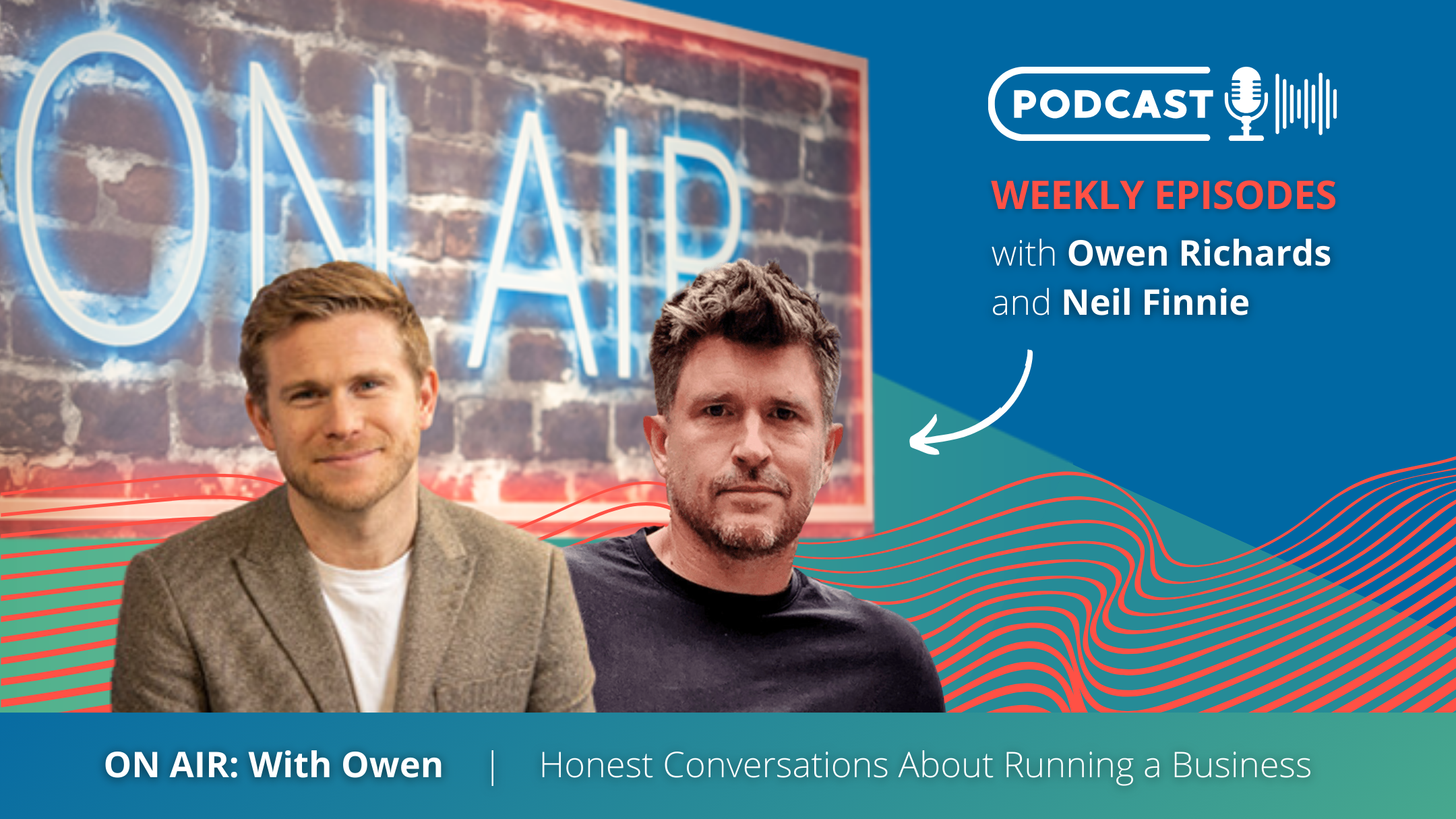
Introducing our 100th(!) episode of ON AIR: With Owen – our podcast series for honest conversations about starting and scaling your own business, hosted by our Founder & CEO, Owen Richards, and his new co-host, Neil Finnie.

Meet Your Hosts: Owen Richards and Neil Finnie

Owen Richards hails from Kent and began his sales career at Forrest Marketing Group in Sydney. After an 8-year stint, Owen returned to the UK and co-founded Air Marketing Group, growing it into a powerhouse offering specialist B2B sales and marketing solutions to businesses across the globe. Known for his relentless positivity and strategic foresight, Owen brings a wealth of experience and a knack for big ideas to the podcast.

Neil Finnie is your quintessential ‘wabi-sabi entrepreneur’ – flawed but beautiful in approach. With over 25 years of experience in nurturing businesses around his passions, from co-working spaces to professional development agencies, Neil’s unique perspective enriches our discussions, making each episode a treasure trove of insights.

What to Expect in this Week’s Episode

Neil is back, and he and Owen are diving straight into the UK budget announcement and its profound impact on businesses.

  • The Business Bottom Line: From national insurance increases to minimum wage adjustments and higher business rates, how will companies cope with these rising costs?
  • A New Monthly Bill: With little time and limited information to prepare, businesses face a financial burden they didn’t account for last year.
  • Jobs and the Future Workforce: What does the budget mean for job creation amid pressures from AI, outsourcing, and escalating employment costs?
  • Employee Rights at Day One: We discuss how this impacts startups and businesses trying to get off the ground.
  • Retirement on Hold: For business owners nearing retirement, the new tax ratio is a game-changer, leaving less time to plan for the future.

Where and When to tune in

Catch new episodes every Wednesday:

Watch: On YouTube or via Air Marketing’s Knowledge Hub.

Listen: On Spotify, Amazon Music, Apple Podcasts, TuneIn + Alexa, Deezer, and more.

Join us as we dive deep into the dynamics of running a business in today’s fast-paced world. Whether you’re seeking inspiration or practical advice, our podcast is your gateway to becoming more adept in the business arena.

Warning: Contains swearing

ON AIR With Owen: Episode 99 | Do You Need a Personal Brand to Succeed?

Introducing our 99th episode of ON AIR: With Owen – our podcast series for honest conversations about starting and scaling your own business, hosted by our Founder & CEO, Owen Richards, and his new co-host, Neil Finnie.

Meet Your Hosts: Owen Richards and Neil Finnie

Owen Richards hails from Kent and began his sales career at Forrest Marketing Group in Sydney. After an 8-year stint, Owen returned to the UK and co-founded Air Marketing Group, growing it into a powerhouse offering specialist B2B sales and marketing solutions to businesses across the globe. Known for his relentless positivity and strategic foresight, Owen brings a wealth of experience and a knack for big ideas to the podcast.

Neil Finnie is your quintessential ‘wabi-sabi entrepreneur’ – flawed but beautiful in approach. With over 25 years of experience in nurturing businesses around his passions, from co-working spaces to professional development agencies, Neil’s unique perspective enriches our discussions, making each episode a treasure trove of insights.

What to Expect in this Week’s Episode

  • The Role of Personal Brands: Is a founder’s brand essential for business success, or can a company succeed without a face? Owen and Neil weigh the pros and cons.
  • Creating Connection and Trust: Owen and Neil debate whether audiences are more engaged with businesses that show a personal side.
  • Owen’s Approach: From in-person events to raw, unfiltered content, Owen shares how he blended personal and professional elements to build his brand.
  • The LinkedIn Landscape: Once just for job updates, LinkedIn is now a crowded space for personal branding. How can you stand out in this environment?
  • Finding Your Balance: There’s no one-size-fits-all for branding. Owen and Neil explore the different ways to build a genuine, authentic presence beyond LinkedIn, and how to find the balance that works for you and your business.

Where and When to tune in

Catch new episodes every Wednesday:

Watch: On YouTube or via Air Marketing’s Knowledge Hub.

Listen: On Spotify, Amazon Music, Apple Podcasts, TuneIn + Alexa, Deezer, and more.

Join us as we dive deep into the dynamics of running a business in today’s fast-paced world. Whether you’re seeking inspiration or practical advice, our podcast is your gateway to becoming more adept in the business arena.

Warning: Contains swearing