

Cold Call Lead Generation for B2B: What Actually Works When You Need Predictable Pipeline

Cold Call Lead Generation for B2B - Air Marketing Leading Outsourced Sales Provider
Cold Call Lead Generation for B2B

Cold call lead generation remains one of the most misunderstood sales channels in B2B.

At Air, we see organisations abandon cold calling not because it fails, but because it is rarely built or managed as a professional sales discipline. When cold calling is treated as a volume exercise, it produces noise. When it is treated as a structured revenue channel, it creates control, visibility, and pipeline predictability.

The difference is execution.

In this article, we explain how cold call lead generation works in modern B2B environments, why it breaks down inside most organisations, and how we design and deliver it as part of an integrated outbound strategy.

Does cold call lead generation still work for B2B companies?

Yes, but only when it is built around buyer relevance and commercial intent.

B2B decision-makers have not stopped answering the phone. What they have stopped responding to are calls that lack context, insight, or a clear reason for engagement. In our delivery work, we consistently see senior buyers engage when calls demonstrate an understanding of their market, role pressures, and commercial priorities.

Cold call lead generation works when:

  • Clearly defined audience: the audience is tightly scoped and relevant to your offer.
  • Problem-led message: the message is rooted in real business problems, not product features.
  • Trained caller capability: the caller is trained to hold a commercial conversation, not read a script.

This is why Air positions cold calling as a conversation channel, not an interruption tactic.

Why cold call lead generation fails inside most organisations

A common pattern we see across growth-stage B2B businesses is that cold calling is deployed without the foundations required for success.

The most frequent failure points include:

  • Activity over outcomes: teams are measured on dials rather than qualified conversations or pipeline contribution.
  • Generic messaging: calls focus on products and features rather than buyer problems and commercial impact.
  • Poor data discipline: target lists are outdated, poorly segmented, or lack insight into buyer context.
  • Isolated execution: cold calling runs separately from email, LinkedIn, and wider outbound activity.
  • Undertrained resources: cold calling is handed to junior hires without the coaching or structure required to succeed.

The commercial impact is significant. Time is wasted, confidence erodes, and cold calling is incorrectly labelled “ineffective”.

How Air builds effective cold call lead generation programmes

At Air, we design cold call lead generation as part of an end-to-end sales delivery system, not a standalone tactic.

1. Precise ICP and role definition

We start by defining exactly who should be called and why. This includes sector, company size, buying triggers, and the specific challenges faced by each decision-maker.

2. Insight-led messaging

Our calls are informed by real sales conversations across markets. Messaging is continuously refined based on what buyers respond to, not assumptions made in isolation.

3. Integrated outbound execution

Cold calls are sequenced alongside targeted email and LinkedIn activity. Each touchpoint reinforces the last, creating familiarity and relevance before and after the call.

4. Professional delivery

Air callers are trained sales professionals, not script readers. They are coached to qualify, challenge, and progress conversations commercially.

5. Continuous optimisation

Performance is reviewed weekly. Messaging, targeting, and approach are adjusted based on outcomes, not gut feel.

This is how cold call lead generation becomes predictable.

How many cold calls does it take to generate a B2B lead?

There is no fixed number, and any provider offering one should be challenged.

In our experience, results are driven by:

  • Data quality: accuracy, freshness, and segmentation of the list.
  • Message relevance: how well the opener and angle map to buyer priorities.
  • Caller capability: ability to qualify, challenge, and progress commercially.
  • Follow-up discipline: structured persistence across calls, email, and LinkedIn.

Well-designed programmes typically require fewer calls, not more, because conversations are better targeted and better handled. This is why Air focuses on conversion efficiency, not call volume.

In-house vs outsourced cold call lead generation

Many organisations attempt to build cold calling internally without appreciating the true cost.

In-house delivery requires:

  • Hiring and onboarding: recruiting and ramping specialist SDRs.
  • Ongoing coaching and management time: training, QA, and performance management.
  • Data, tooling, and process ownership: keeping lists clean, systems running, and messaging updated.
  • Time to reach consistent performance: ramp time before predictable pipeline appears.

Outsourcing cold call lead generation to Air gives organisations access to:

  • Proven sales processes: delivery built around outcomes, not activity.
  • Experienced delivery teams: trained callers who can run commercial conversations.
  • Immediate market insight: learning from live buyer conversations, in real time.
  • Transparent reporting and accountability: visibility into activity, outcomes, and pipeline contribution.

For businesses that need pipeline now, outsourcing removes execution risk while maintaining control.

What good cold call lead generation looks like in 2026

Effective programmes share the same characteristics:

  • Clear commercial intent: every call has a defined purpose and qualification standard.
  • Buyer-led conversations: relevance, context, and commercial outcomes lead the dialogue.
  • Integrated outbound execution: calls reinforce, and are reinforced by, email and LinkedIn.
  • Measurable pipeline contribution: performance is tracked through qualified conversations and opportunities created.

At Air, we build cold call lead generation to support revenue growth, not vanity metrics. The objective is always the same: qualified conversations that progress into real pipeline.

Related reading

Is Telemarketing Still Effective for B2B Lead Generation?

This article explores how telemarketing, cold calling, and modern outbound should be combined to build predictable B2B pipeline.

Commercial next step

If your outbound activity feels inconsistent, or your internal team lacks the time or structure to make cold calling work properly, Air builds and delivers cold call lead generation as part of a wider sales system designed to produce predictable pipeline.

If you want to see how this would work for your market, we are happy to talk through a practical approach.

Complete the form below and we’ll get back to you within one working day.

Talk to an expert at Air Marketing - Trusted Outsourced Sales Agency UK

Why AI Products Don’t Sell Themselves (And Never Will)

AI Sales Strategy for AI Products | Outsourced Lead Generation & Sales Support - Air Marketing
Why AI Products Don’t Sell Themselves (And Never Will)

Why AI Products Don’t Sell Themselves (And Never Will)

Over the last year, we’ve seen a clear shift in demand, with a growing number of AI companies coming to us for sales support.

These are not early-stage experiments. They are businesses with sophisticated models, credible use cases, and genuine technical differentiation. The assumption was simple: build something intelligent, put it into the market, and growth will follow.

It hasn’t.


The false promise of ‘self-selling’ AI

AI founders are often sold the idea that innovation removes the need for traditional sales effort. In reality, B2B buying behaviour hasn’t fundamentally changed.

Related reading: We’ve covered this in more depth in Inbound Plateaued? Here’s How Outbound Can Restart Your Growth Curve , which looks at why inbound-only growth stalls and how outbound reintroduces momentum.

Decision-makers are still risk-averse. They still need reassurance. They still want to understand not just what the technology does, but what it means for their business, their team, and their credibility internally.

What we’re seeing from AI companies coming inbound

There’s a striking consistency across conversations with AI businesses. The same challenges keep surfacing:

  • Strong inbound interest, but low conversion
  • High demo volumes, but stalled decisions
  • Technically impressive products that struggle to articulate commercial value
  • Heavy reliance on automation, with minimal human follow-up

Why old-fashioned sales is outperforming modern automation

Despite advances in automation, the highest-performing AI GTM motions still rely on fundamentals:

  • Human-led discovery calls that uncover real commercial pain
  • Sales conversations that translate models into outcomes
  • Objection handling in real time, not via nurture sequences
  • Consistent follow-up driven by people, not workflows

Yes, automation accelerates process, but it does not replace trust.

Why AI founders are choosing to outsource SDRs rather than hire internally

For many AI founders, the decision to outsource SDRs isn’t about cost-cutting. It’s about speed, focus, and reducing execution risk.

Hiring internally looks straightforward on paper. In practice, it introduces friction at exactly the point where momentum matters most.

Hiring slows the GTM learning loop

Recruiting, onboarding, training, and iterating messaging can take months. Outsourced SDR teams allow founders to test positioning, markets, and messaging in weeks, not quarters.

Founder-led sales doesn’t scale

Many AI businesses rely on founders to sell early on. That works until it doesn’t. Outsourced SDRs create separation between product leadership and pipeline creation, without founders stepping completely away from sales insight.

Good SDRs are hard to find – and harder to ramp

AI propositions are complex. Hiring junior SDRs and expecting them to confidently sell advanced technology is a high-risk bet. Outsourced teams bring experience, structure, and commercial discipline from day one.

Consistency matters more than headcount

One or two internal SDRs can struggle with momentum through holidays, churn, or underperformance. Outsourcing provides coverage, process, and continuity without single points of failure.

AI companies want signal, not noise

The goal isn’t activity volume. It’s learning what resonates, what converts, and why. Outsourced SDR teams are often brought in to generate commercial signal that sharpens product, marketing, and pricing decisions.

For AI founders, outsourcing SDR isn’t a shortcut. It’s a way to build confidence in the GTM motion before committing to permanent headcount.

That’s why we’re seeing more AI companies treat outsourced SDR as a strategic bridge – not a replacement for an in-house sales team, but a faster route to one that actually works.

Where this leaves AI companies

The most successful AI companies are not choosing between technology and humans. They are deliberately blending both.

AI sharpens targeting, personalisation, and insight. Human sales teams provide credibility, context, and reassurance.

If your AI product isn’t converting at the rate you expected, the issue is rarely the model. It’s usually the missing human layer around it.

Conclusion

AI will keep evolving. The fundamentals of B2B buying will keep demanding confidence, clarity, and human reassurance. The winners won’t be the businesses with the cleverest product – they’ll be the ones that can consistently translate it into commercial outcomes.

If this sounds familiar, speak to one of our experts about how our lead generation and outsourced SDRs services are helping AI companies turn technical capability into consistent, predictable revenue.

SaaS Growth 2026: How Leading Brands Are Building Predictable Sales Pipelines

SaaS Companies Revenue Growth 2026 - Air Marketing Outsourced Sales Agency UK
SaaS Growth 2026: How Leading Brands Are Building Predictable Sales Pipelines

SaaS Growth 2026: How Leading Brands Are Building Predictable Sales Pipelines

The pressure on SaaS growth is changing. The SaaS landscape is shifting – fast.

Recent data shows:
  • The average B2B SaaS sales cycle has increased from 107 to 134 days – roughly a 25% rise year-on-year.[1]
  • Fewer than one in five SaaS firms say they have full confidence in their pipeline forecasts.[2]
  • Organisations that define and enforce a structured sales process see up to 28% more revenue than those that don’t.[3]

In 2026, success won’t be defined by who shouts the loudest or automates the fastest – but by who builds the most reliable system for generating qualified opportunities month after month.

Why predictability has become the new currency

  • Clarity over chaos – clean data, structured processes, and defined ICPs.
  • Performance over volume – fewer, better-qualified conversations.
  • Integration over isolation – SDRs, marketing, and sales ops working as one revenue engine.

The playbook behind predictable SaaS pipelines

  • Rebalancing inbound and outbound. Outbound is no longer an afterthought – it’s a precision tool for creating qualified conversations in defined markets.
  • Building SDR teams that think commercially. The best SaaS SDRs understand value, not just volume. They know how to open a conversation that leads to revenue.
  • Using data as a decision driver. From call performance to conversion ratios, data fuels continual optimisation – not micromanagement.
  • Investing in training and culture. Predictable performance comes from confidence, coaching, and clear career progression, not scripts and spreadsheets.

Outsourced SDR models are rising in influence

  • Faster setup and scalability.
  • Proven processes and playbooks.
  • Access to skilled SDRs trained to represent your brand with precision.

Sources

  1. MADx Digital – SaaS Sales Statistics 2025: Average B2B SaaS Sales Cycle Increased from 107 to 134 Days. madx.digital
  2. Forecastio – SaaS Sales Forecasting Challenges and Confidence Levels. forecastio.ai
  3. SuperOffice – Organisations that define and enforce a sales process see up to 28% more revenue than those that don’t. superoffice.com

Ready to see the difference for yourself?

If you want outbound that delivers revenue, not just activity, let’s talk about what a performance-led model could do for your pipeline.

Maximising Sales Performance: Should You Go In-House or Outsourced for Training?

It’s not your imagination, sales development is definitely getting harder. Outbound prospecting is certainly getting harder. Doing the same thing, applying the usual techniques, won’t cut it anymore. More than ever, there’s a need to be coaching and training your SDRs regularly, particularly in the early part of their career.

But what’s the best way to train your sales team? Should you have an in-house trainer or send SDRs to external training courses? Here, we’ll look at the pros and cons of in-house and outsourced sales training and enablement.

Benefits of in-house sales training

Awareness of the business: A trainer who works within the business knows the internal values, processes and systems. You can work through real life situations and confidential case studies.

Ongoing support: In-house trainers are able to train and coach consistently, and provide ongoing support. They’re not simply providing a one-off session, never to be seen again.

Accountability: Working in-house, the trainer can hold participants to account and follow up on the training with them. 

Challenges of in-house sales training

Expensive commitment: There’s the ongoing cost of hiring trainers rather than the variable outgoing of paying for external training courses.

Repetition of content: In-house trainers tend to teach the same things again and again. Being ‘in the bubble,’ they’re less exposed to new, external content and ideas. As Albert Einstein wisely pointed out, “Insanity is doing the same thing over and over again and expecting different results.”

Colleagues as fellow students: Training alongside your team mates tends to mean that you’re bringing similar experiences to the table. You’re not learning about different environments, challenges and case studies.

Benefits of outsourced sales training

Experts in their field: External trainers tend to be subject matter specialists. They’re constantly learning and updating their knowledge to pass on to their students.  

Established programs: Outsourced training is generally a one stop shop. Participants follow a program over a set time (e.g. a one day or half day training session). It’s a well-established and prepared program with specific processes.

Diversity of participants: External training providers usually hold sessions for people from different companies. They’ll bring varying levels of knowledge and understanding, and differing experiences. You’ll learn from each other as well as the trainer. 

Challenges of outsourced sales training

Cost of training courses: Outsourced sales training can be a costly option. Some providers charge £5000+ per day, for example.

Lack of accountability: After your training course, you go back to work and carry on. All too often, you drift back to old habits instead of the new ideas that you learned about. Without anyone to hold you to account, it’s easy to stick with what you know.

Finite learning experience: Once your six hour or six week training program ends, that’s the end. There’s no follow up to check your understanding of the topic, to build on it or to see if you’re successfully implementing the new approach. 

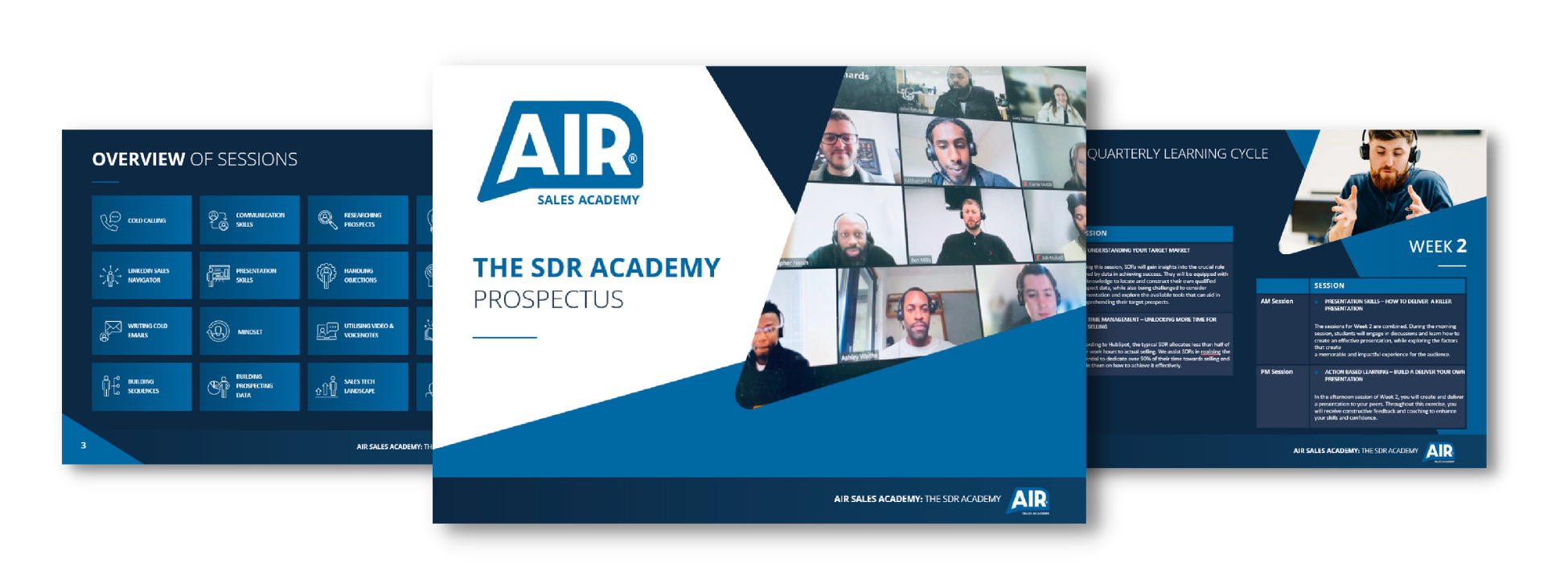
Introducing a different approach – The SDR Academy

We believe The SDR Academy offers something truly different.

The SDR Academy’s unique offering involves both learning new things as well as topping up and refreshing existing knowledge. We hold SDRs accountable for what they’ve learnt with regular sessions every single week. It’s the best of both worlds – a continuous learning journey combined with external expertise and learning from other people with different experiences.

We believe that sales training doesn’t have a beginning and end. You don’t have one session on ‘objection handling’ and then handle every instance perfectly. You don’t attend a session on ‘writing cold emails’ and then compose winning emails every time. You never complete your learning around sales. It’s an evolution; a process of continuous improvement.

The SDR Academy is an ongoing subscription to virtual training sessions. Run in live, virtual rooms, the courses are created and facilitated by leading industry experts. It’s comprehensive, affordable and impactful.

How To Effectively Convert MQLs From Gated Content

Acquiring Marketing Qualified Leads (MQLs) is just the beginning when it comes to Digital Marketing. Next comes the trickier part: effectively nurturing and converting those leads into loyal customers.

In this blog, we’re looking at how to effectively convert MQLs from gated content downloads, with a strategic approach that guides prospects seamlessly through their buying journey.

Here are 10 strategies to effectively nurture and convert MQLs into valuable customers:

  1. Segment and Personalise

Segmentation is key. Group MQLs based on demographics, behaviour, and where they are in their journey. Then, personalise your content to cater to the specific pain points and needs of each segment.

  1. Lead Nurturing Campaigns

Gradually introduce relevant content and take advantage of a multi-channel approach by engaging leads across various platforms like email campaigns, social media and webinars.

  1. Content Mapping

Align your offerings with the different stages of the buyer’s journey. Provide informative content at every step to guide leads closer to conversion.

  1. Engagement and Interaction

Use interactive content tools such as live webinars, polls, calculators and ROI tools to engage leads and gather valuable insights. Encourage prompt interaction and respond swiftly to inquiries.

  1. Qualification

Define clear criteria for when a Marketing Qualified Lead (MQL) becomes a Sales Qualified Lead (SQL).

  1. Continuous Analysis and Optimisation

Keep a close eye on your metrics. Monitor KPIs such as conversion rates and engagement metrics. Continuously experiment through A/B testing to optimise your nurturing campaigns.

  1. Sales and Marketing Alignment

Ensure strong collaboration between your marketing and sales teams. Foster open communication and create a feedback loop to refine MQL criteria and nurturing strategies.

  1. Customer-Centric Approach

Focus on value. Showcase how your product or service resolves specific pain points rather than just its features. Offer educational resources that empower leads to make informed decisions.

  1. Lead Follow-Up

Timing is everything. Ensure swift follow-ups and sustained engagement with your leads. Automate reminders within your CRM to maintain the conversation flow.

  1. Retargeting and Remarketing

Utilise retargeting ads and personalised offers to re-engage MQLs who have shown interest but haven’t converted yet.

By applying these strategies with precision and dedication, you can effectively nurture and guide MQLs through their journey, transforming them into loyal customers. This approach will not only boost conversions but also foster long-term relationships with your audience, driving sustainable growth for your business.

Opinion piece by Digital Marketing Manager, Becca Duckering

All You Need to Know About Using Data in Outbound Sales

At the close of last year, our exclusive roundtable, hailed by viewers as ‘the event of the year’ and one of our most successful yet, brought together the leading minds from all major data providers in the industry to discuss everything you need to know about using data in outbound sales. Offering key insights across strategy, intent data, data accuracy and the best practices for utilising data – it’s an absolute must-watch for anybody involved in the sales process.

Hosted by Air’s Founder & CEO, Owen Richards, our expert panel featured:

Here, their insights are revealed:

Everything Starts with Your ICP

“Many clients don’t know what their TAM (Total Addressable Market) is” says Liz Fulham. One of the common pitfalls of outbound sales is the spray and pray approach.

Ringing everyone on a list with no process or targeting strategy in place is what Paul Gilhooly calls a sure “revenue and productivity killer.”

The best way to lift your revenue line is to know who to target, what their pain points are and “how your solution fits into your prospect’s organisation” as Saif Khan offers.

Have an Efficient Operating Model

The importance of having a clear and efficient operating model within sales cannot be overstated. After all, data and outbound go hand in hand.  A good operating model will tie into that strategy and allow you to maximise your data for success. Paul Gilhooly informed us that 5-10% of your TAM will be in-market at any given moment. Ensuring that you have a process of capturing those accounts will help you to prioritise the most important accounts that are in-market for your solution. As he is says “In this economy, missing out on opportunities is the worst, so if you don’t have a process for that you’re missing a trick.”

Saif echoes and elaborates on the importance of having the tools and a blueprint of how you’re going to reach your goals. “The two biggest things are alignment and resource allocation” he says. With everyone in the team being asked to do more with less these days, it’s important that sales and marketing teams communicate and that you are providing for the accounts that have the highest yield. It’s not enough to focus on the leads generated at the top of the funnel anymore, so leveraging data from all departments to inform how you approach sales is fundamental. 

Using Data Effectively

Many companies come to data providers with the goal of enhancing their revenue but think they need to “rip and replace” all the data they have collected so far. Saif says it’s actually all about assimilating what has worked up until now and leveraging the right solutions to understand where the volume and quality of leads can be improved. When you understand the bigger picture, you can build short- and long-term plans for your success.

AI

AI is changing the world. It has so many uses within outbound sales such as helping SDRs to create ICPs based on their best-selling customers. Paul Gilhooly also explains how within 6sense’s platform it can be used to do a statistical lookback at the last few years of your CRM data and identify key trends and opportunities.

AI can be instrumental in getting the timing of outreach right, as well as providing a workflow to help you to prioritise the best opportunities. Liz explains that “using AI we’re able to match the data in the CRM to bring it right up to date with what’s happening on the internet.” In fact, it’s so powerful that it can update a changed job role from LinkedIn within minutes. This is amazing for reducing duplication and data accuracy.

Intent Data

Intent data is all about understanding the dynamic of how people buy today. Paul offers up two key questions here:

  • Do we want to contact the people who we could sell to?
  • Or do we want to contact people who want to buy?

From there you can ascertain what sales opportunities there are and if they are really feasible.

With first- and third-party data to consider as well as anonymous data there is lots to consider and much research emerging too. Rather than looking at one subset of data, it’s important that you aggregate it to get a full picture of your ICP’s pain points, needs and buyer readiness.

Outbound Sales Best Practices

  • Opt for Account-Based selling over transactional selling
  • Take a multi-channel approach – don’t just sell through the phone
  • More doesn’t mean more, its quality that counts
  • Personalisation, relevance and timing have never been more important
  • Leverage what you already have alongside intelligence tools
  • Offer a bespoke, tailored approach at every stage of the sales cycle
  • Profile the right companies to call using the data
  • Work on accounts that align to who the AE is going to sell to
  • Know your sales hooks
  • Be intentional with how you use data
  • Always A/B test
  • Ask the right questions
  • Be patient

It’s pays to remember that there is no one size fits all when it comes to sales and marketing intelligence. James Isilay summarised it well when he said “data providers are a bit like newspapers. We all have different ways of collecting data and different propriety signals that we overly on that. There’s always differences in our data and accuracies. We all make a different soup in how we bring the data together.”

The most important thing is that you engage influencers and decision makers within a company in the right conversations, demonstrating that you understand their challenges and have a specific solution to ease them.

Outbound sales should be a collaborative approach laser-focused around your prospects. Making effective use of data at every stage of the sales process is vital especially within the mid to end of the funnel where there is so much intelligence to be gleaned.

As James says “Don’t burn the opportunities that you do get. They’re so hard to come by right now – they’re like golden nuggets!”

Thank you to our excellent panel for their time and knowledge. We hope that you found this roundtable as engaging and insightful as we did!

The SaaS Blueprint: Building Brand Trust Through Unified Outreach

When delving into the world of SaaS, it’s easy to become overwhelmed by the myriad of strategies and methods on offer. Yet, one fundamental truth stands out: our approach truly counts.

Now, there’s no denying the time-tested efficacy of the phone. There’s something about the immediacy of voice, the rapport it establishes. It’s undeniably our ace in the hole. However, let’s face it, we’re in a digital era, and platforms like Email and LinkedIn are simply indispensable. They’re not mere add-ons; they’re part of the core trio. These platforms grant us the ability to engage potential clients in diverse yet equally impactful ways, and when used effectively, they each compliment and bolster the others.

This brings me to another key point: the potential outcomes when sales and marketing join forces. The era when sales and marketing operated in their own bubbles is, thankfully, bygone. In today’s world, especially within SaaS, the fusion of the two has led to some incredible results. Our SDR teams receive these qualified, nurtured, warm leads, transforming conversions into genuine dialogues.

A unified front is essential. It’s not just about the message but ensuring it’s delivered harmoniously. If our marketing colleagues are communicating a narrative, it’s pivotal we’re all on the same page, talking the same language and replicating each other’s approach. This alignment doesn’t just enhance our brand’s authenticity, it amplifies it, particularly when our SDRs are reaching out.

Lastly, there’s the matter of brand trust. With marketing standing shoulder to shoulder with sales, reinforcing the narrative, it’s akin to bestowing our brand with a seal of credibility. And trust me, that doesn’t go unnoticed.

In conclusion, as the SaaS industry continues to grow and evolve, it’s pivotal that we remain agile, adaptive, and most importantly, integrated in our approach. By ensuring that our sales and marketing efforts are not just aligned but intertwined, we position ourselves for sustained success and growth. Always remember the basics: integration, consistency, and collaboration.

See how this simple, collaborative approach has led to many success stories with clients the SaaS sector, here.

Opinion piece by Sales Director, Marco Alfano-Rogers

Why it’s never too early for SaaS businesses to invest in their sales strategy

All hype and a lackluster product are a common phenomenon. We’ve all been seduced by a miracle product that promises so much but underwhelms. But what about the flipside? What happens when you spend all your time focused on technology development and neglect to think of the future sales? It’s tempting to believe that a truly fantastic product will sell itself. Sadly, this is a modern fable of the highest order. Every major new tech development of the past 10 years has been backed by a sound sales and marketing strategy because nothing drives new product investment better than a solid first year’s sales figures.

In the SaaS industry, success is largely predicated on those early sales, as an estimated 92% of SaaS companies fail within 3 years. Despite growth and funding, securing pipeline and a stronghold in the market is even more vital.

It’s a tough situation because it’s natural for entrepreneurs to hold back on marketing and sales plans when they feel their product requires further development but it’s also this lack of planning beyond the initial investment that can prove a seriously limiting factor.

So, if you’ve secured investment, found a perfect product market fit and are confident in your value proposition and pricing, you’re way ahead of most of your competitors. But in a high growth and extremely saturated market, that’s not enough to edge the competition. Beige, generic and all-encompassing messaging that doesn’t help your product stand-out, coupled with a less than expert sales approach, isn’t the winning combination that will help you succeed.

Define your market and nurture it

It’s true, there’s a global market out there if you’re an SaaS business, and even if you’ve validated the market need for your product with extensive research, you still need to have a consistent, defined approach to influencing the decision makers in the businesses who have the most need for what you’re selling. Even if you have the perfect product to solve their business challenge, if your sales strategy and approach to prospecting doesn’t include a thorough discovery process, you could be missing out on valuable prospects and upsell opportunities. Our team are experts in guiding and influencing these conversations, gathering valuable insight throughout their conversations.

Invest in lead generation

If you’re new to the market and your organic traffic and enquiries need a boost, investing in lead generation can not only directly feed your pipeline but drive valuable traffic to your website, and can help you build brand and reputation when you’re still trying to expand your reach.

Stop firefighting and trust a sales expert

We’ve covered the issue of allocating a budget to outsourcing sales in our blog How to decide what to spend your investment on. A big part of this is understanding that the right team is essential to success. When you’re just starting to get established, it’s frustrating for team members to lead functions where they have limited expertise. You can be a genius developer with a talent for securing investment but that doesn’t mean you know how to create a winning sales strategy, tailor conversations that convince decision makers to part with their cash or seamlessly adjust the script to keep a prospect warm and interested. That’s what our team can do for you, giving you back valuable time to focus on core business.

The Covid-19 effect

The pandemic has seen SaaS sales rise, thanks to increased digitisation of services expedited by the shift to remote work. Who knows how long the boom will last? What we do know is that when budgets tighten, SaaS services will have to prove their mettle and stay close to both customers and prospects to keep churn low and convince new customers to part with their cash, making a consistent approach to account managing existing customers and nurturing new relationships even more vital.

If you’d like to find out more about how we can help you create a winning sales approach that will ensure a strong pipeline as the market recovers, get in touch: call 0345 241 3038 or email contact@air-marketing.co.uk.

How SaaS companies are reaping the benefits of outsourcing their Sales Development Representative (SDR) roles – now’s the time to take the leap

In the SaaS market, outbound sales are crucial to scale and grow at the rate needed to remain competitive and deliver that initial return on investment necessary not only to validate their product but to ensure their company’s future.

While an annual growth rate of 20% is a healthy benchmark for businesses in other industries, software companies growing at that rate have a 92% chance of failure in just a few years according to McKinsey & Company. Further cementing the pressure to succeed for tech businesses in those crucial early months.

For most, their product has spent many months in development, they’re confident in their value proposition, their market research and their messaging. With this level of pressure to make it succeed, there is no doubt going to be a level of nervousness in handing over the reins to an outsourced partner to support taking that product to market.

But there are clear and well-documented benefits to outsourcing sales, especially for a high growth model like SaaS. Developing a high-performance sales process takes time and expertise. For companies looking to fast track growth and build pipeline, they may not have months to build a sales culture primed for success. In fact, building an SDR function in-house comes with many challenges; you need to recruit the right people, retain the best performers and spend time training and managing those who don’t come up to the mark.

Fast growth means high churn

Research shows the turnover rates average at 39% for players in the high growth SaaS market, with contributing factors including burnout, poaching from more recognised brands with established career pathways and simply the nature of working in a fast-paced environment. If you consider average ramp-up time is just over 3 months for most SDRs, it becomes clear why it makes sense to work with a partner who specialises in recruiting and retaining talented SDRs. A related benefit of outsourcing is protecting the in-house sales talent tech businesses need to retain, by allowing them to focus on closing deals rather than spreading themselves thinly across prospecting and short-term promotions.

Building a sales culture for success takes time

A successful sales culture is reliant on great team relationships, a comprehensive onboarding and training programme and the right mix of employee benefits and incentives. At Air, we’re proud of our culture and the journey our SDRs have taken from new recruits to experienced individuals with enviable track records. But it didn’t happen overnight, our people have honed their experience through working on diverse and complex campaigns and growing in confidence and experience with each client collaboration. This means they can hit the ground running with new campaigns and are already familiar with the challenges across a range of SaaS clients, so can leverage their experience and insight into industry challenges to build rapport with key decision makers. For more insight on this topic, watch our vlog where we explore the challenges of Growing a team of Sales Development Representatives.

Air’s outsourced model

We help our SaaS clients fast track to success with Air’s outsourced SDR model, removing the burden of developing their in-house sales specialism and giving them back time to focus on their operations, service and product development. If you are a SaaS business looking for support, we can help.

Scale your outreach

We believe that there’s nothing more effective in a sales process than a good, human to human conversation. Our expert team of SDRs will scale your reach, increasing your brand awareness and potential sales opportunities.

Build your pipeline

A healthy sales pipeline of qualified leads that will convert is vital to your plans to scale. Our team of highly skilled SDRs effectively engage with your ideal target audience, to give you the best chance of making a sale.

Convert prospects

We’ll work with you to increase revenue from new sales. Our talented Sales Development team will not only create pipeline but cover the full sales cycle.

To discover more about how we work with SaaS businesses and the results we achieve check out our case studies. If you’d like to start a conversation about how we could work together to help your business grow, call 0333 250 3217 or email contact@air-marketing.co.uk.