
The 7 Mistakes Companies Make When Hiring Their First SDR

The 7 Mistakes Companies Make When Hiring Their First SDR

For many growing businesses, hiring their first Sales Development Representative feels like a natural step. The Founder has been doing most of the selling, pipeline is inconsistent, and growth targets are increasing. Bringing in a dedicated salesperson appears to be the logical next move.

But building a successful outbound function is rarely as simple as hiring one person and expecting results.

Having worked with hundreds of organisations developing their sales functions, we regularly see the same mistakes appear again and again. Avoiding these pitfalls can save months of frustration and significant investment.

1

Hiring Before Building a Sales Plan

Many companies jump straight to recruitment.

The thinking is simple: we need more sales activity.

But without a clear plan, even experienced SDRs struggle to succeed.

Before hiring, organisations need clarity around:

  • target markets and ideal customer profiles
  • messaging and value propositions
  • qualification criteria
  • sales process structure
  • lead handover between SDR and closing teams

This is where an outbound sales playbook becomes critical. It provides the structure that enables new hires to operate effectively from day one and ensures your team is targeting the right prospects with the right messaging.

2

Expecting an SDR to Replicate Founder Success

Founders often underestimate how much of their own success comes from:

  • deep product knowledge
  • personal credibility
  • autonomy in conversations
  • passion for the business

A new hire simply does not have those advantages.

Expecting an SDR to immediately replicate founder-level results can quickly lead to disappointment. Even highly capable salespeople need time to develop confidence in the product, the market and the messaging.

3

Underestimating Ramp Time

Many businesses assume that once hired, an SDR will start producing meetings almost immediately.

In reality, most SDRs require three to six months before consistently generating pipeline.

During that time they must learn:

  • the market
  • the product
  • the messaging
  • the sales process
  • the objection landscape

Structured training and coaching are essential to accelerate that learning curve. In fact, this is exactly how we build high-performing outsourced SDRs within our own programmes.

Without that structure, early performance can appear disappointing and organisations may lose confidence in their investment before the foundations are in place.

4

Hiring the Wrong Type of Salesperson

Not all sales professionals are the same.

An SDR responsible for high-volume outbound activity requires a very different skill set from someone navigating complex enterprise buying groups.

When hiring your first SDR, businesses must think carefully about what the role actually requires.

For example:

  • high activity outreach versus account-based engagement
  • simple product conversations versus technical discovery
  • short sales cycles versus long consultative deals

Each of these scenarios requires a different type of salesperson.

Getting that match wrong can quickly slow pipeline development.

5

Ignoring the Importance of Data

Even highly capable SDRs cannot succeed without quality data.

Without a defined data strategy, new hires can spend large amounts of time:

  • researching prospects
  • validating contact information
  • identifying suitable target accounts

This dramatically reduces time spent actually selling.

Strong outbound performance depends on clear target profiles and access to clean, segmented data that enables SDRs to focus on conversations rather than research.

6

Underestimating the True Cost

Salary is only one component of building an SDR function.

Organisations must also account for:

  • recruitment costs
  • ramp time
  • sales technology
  • leadership management time
  • attrition risk

When everything is factored in, the real investment can easily exceed £70k-£100k in the first year before predictable pipeline emerges.

Many organisations only discover this after attempting to build the function internally.

7

Expecting Immediate ROI

Outbound pipeline takes time to build.

Deals generated today may not close for months depending on the sales cycle.

If expectations are misaligned internally, leaders can lose confidence in the investment before it has had time to deliver results.

A realistic plan for pipeline generation, opportunity creation and revenue forecasting is essential. Many organisations discover these challenges when reviewing their sales process and identifying where pipeline performance is breaking down.

Building a Sales Function the Right Way

Hiring your first SDR can absolutely be the right move. But success rarely comes from recruitment alone.

High-performing outbound teams are built on strong foundations:

  • a clear sales playbook
  • well-defined target markets
  • consistent messaging
  • structured coaching
  • realistic expectations around pipeline timelines

For some organisations, building this capability internally makes sense. For others, working with an outsourced SDR team can provide a faster route to consistent pipeline while avoiding the challenges of recruitment, ramp time and management overhead.

Final Thought

As Air Marketing Founder & CEO, Owen Richards, often says:

“You’re far more likely to get it wrong before you get it right.”

The key is learning from the mistakes others have already made.

If you’re reviewing how to build or scale your outbound function, we’re always happy to share what we’re seeing across B2B sales teams and how different organisations are approaching pipeline generation.

Complete the form below and we’ll get back to you within one working day.

Talk to an expert at Air Marketing - Trusted Outsourced Sales Agency UK

From Candidate to Closer: How We Build High-Performing Outsourced SDRs

Skilled outsourced SDRs from Air Marketing

An outsourced SDR should not be “ready-made”. They should be built, trained, tested and supported.
In B2B outbound sales, the difference between activity and pipeline is skill. That skill does not appear by accident. It is developed through deliberate recruitment, structured training, coaching, and real-world exposure.

At Air Marketing, we invest heavily in the journey from candidate to closer. Because when we resource outbound campaigns for clients, we are not simply allocating headcount. We are deploying trained, performance-ready professionals who understand how to represent complex brands and generate predictable pipeline.

This is the journey of an Air SDR.


Why Most Outsourced SDR Models Fall Short

A common pattern across growth-stage businesses is this:

  • They need pipeline quickly
  • They hire fast
  • They train lightly
  • They hope for results

The problem is obvious.

Outbound sales is a specialist discipline. It requires commercial intelligence, resilience, structured process, market understanding and conversational skill.

Without proper development:

  • Messaging becomes generic
  • Objections are mishandled
  • Targeting lacks nuance
  • Data is underused
  • Performance fluctuates

Clients feel the impact immediately.

We believe an outsourced SDR should feel like an embedded expert, not a temporary resource. That requires investment before a single call is made.


The Air SDR Journey: From Application to Live Campaign

Our recruitment and onboarding process has evolved over time. What follows is the structure we have refined over the last two years.

It is deliberate. It is performance-led. And it is designed to ensure clients receive skilled outbound sales capability from day one.

1

Stage 1: Application With Voice Note – Testing Communication Early

We begin with a written application and a short voice note.

Why?

Because sales is spoken performance. Tone, clarity, energy and confidence matter.

The voice note gives us insight into communication style, natural presence, commercial maturity, and willingness to step outside comfort zones. We are not looking for perfection. We’re looking for potential and coachability. This ensures we identify candidates with the foundational traits required for outbound sales development.

2

Stage 2: Interview – Assessing Commercial Mindset

Successful applicants are invited to interview with senior leadership and a Team Manager.

This stage focuses on resilience and mindset, curiosity and learning agility, understanding of commercial drivers, and cultural alignment with a target-driven environment.

Outbound performance is not purely technical. It is behavioural. We assess both.

3

Stage 3: Live Roleplay – Proving Sales Instinct

Every candidate completes a mock cold call roleplay with an existing BDE.

This is not theoretical. It tests objection handling, active listening, structure, confidence under pressure, and ability to think in real time.

This step is critical in ensuring we resource clients with SDRs who can operate in real outbound environments.

4

Stage 4: Campaign Allocation Before Day One

Based on roleplay performance and previous experience, we allocate the SDR to their first campaign before they start.

This matters.

Campaign allocation is strategic. We consider sector complexity, target persona seniority, sales cycle length, and messaging sophistication.

This allows induction to be aligned to real client context, not textbook sales.

5

Week 1: Induction, Systems and Sales Foundations

The first week includes full induction, sales process training, systems training, CRM and reporting structure, compliance and data handling, market immersion, and structured call framework training.

By Friday, there is controlled calling exposure.

Why introduce calling early?

Because confidence is built through action, not theory.

6

Week 2: Live Campaign With Ongoing Coaching

In week two, the SDR begins live calling on their allocated campaign.

Alongside this, additional training sessions run, calls are monitored and coached, objections are deconstructed, and messaging is refined.

Performance is not left to chance. It is supported daily.

7

Week 3 Onwards: Scaled Responsibility

If ready, and if campaign need dictates, a second campaign may be allocated.

This decision is based on call quality, meeting quality, confidence, feedback from Team Managers, and early conversion indicators.

8

The 3-Month Probation: Structured Performance Development

Probation lasts three months.

During this time, performance metrics are tracked closely, conversion rates are analysed, coaching is continuous, strengths and development areas are identified, and campaign suitability is reviewed.


What This Means for Clients

When clients engage Air Marketing for outsourced SDR support…

They are not receiving They receive
  • A temporary telemarketer
  • A junior resource without structure
  • A plug-and-play operator
  • A fully trained Sales Development Representative
  • Embedded into their brand and proposition
  • Operating within a proven outbound framework
  • Supported by Team Managers, HR & Operations
  • Backed by performance reporting
  • Continuously coached and optimised

The Commercial Impact of Proper SDR Development

  • Higher quality conversations
  • Stronger meeting conversion rates
  • Better alignment with ICPs
  • More accurate qualification
  • Stronger forecasting confidence
  • Reduced ramp time
  • Lower performance volatility

Outbound is a performance discipline. When skill meets data, activity converts into pipeline.


From Candidate to Closer – And Beyond

The journey does not end at probation.

Ongoing development, campaign evolution and performance refinement continue throughout the lifecycle of every outsourced SDR engagement.

Because we are not simply supplying activity.

We are building revenue engines.

And that begins long before the first call is dialled.


Ready to See What a Properly Built Outsourced SDR Function Looks Like?

If you are evaluating outbound support, ask one simple question:

“How are your SDRs recruited, trained and developed?”

If the answer is vague, so will the results be.

If you would like to understand how our structured SDR model could embed into your growth strategy and build predictable pipeline, we would welcome the conversation.

Complete the form below and we’ll get back to you within one working day.

Talk to an expert at Air Marketing - Trusted Outsourced Sales Agency UK

Maximising Sales Performance: Should You Go In-House or Outsourced for Training?

It’s not your imagination, sales development is definitely getting harder. Outbound prospecting is certainly getting harder. Doing the same thing, applying the usual techniques, won’t cut it anymore. More than ever, there’s a need to be coaching and training your SDRs regularly, particularly in the early part of their career.

But what’s the best way to train your sales team? Should you have an in-house trainer or send SDRs to external training courses? Here, we’ll look at the pros and cons of in-house and outsourced sales training and enablement.

Benefits of in-house sales training

Awareness of the business: A trainer who works within the business knows the internal values, processes and systems. You can work through real life situations and confidential case studies.

Ongoing support: In-house trainers are able to train and coach consistently, and provide ongoing support. They’re not simply providing a one-off session, never to be seen again.

Accountability: Working in-house, the trainer can hold participants to account and follow up on the training with them. 

Challenges of in-house sales training

Expensive commitment: There’s the ongoing cost of hiring trainers rather than the variable outgoing of paying for external training courses.

Repetition of content: In-house trainers tend to teach the same things again and again. Being ‘in the bubble,’ they’re less exposed to new, external content and ideas. As Albert Einstein wisely pointed out, “Insanity is doing the same thing over and over again and expecting different results.”

Colleagues as fellow students: Training alongside your team mates tends to mean that you’re bringing similar experiences to the table. You’re not learning about different environments, challenges and case studies.

Benefits of outsourced sales training

Experts in their field: External trainers tend to be subject matter specialists. They’re constantly learning and updating their knowledge to pass on to their students.  

Established programs: Outsourced training is generally a one stop shop. Participants follow a program over a set time (e.g. a one day or half day training session). It’s a well-established and prepared program with specific processes.

Diversity of participants: External training providers usually hold sessions for people from different companies. They’ll bring varying levels of knowledge and understanding, and differing experiences. You’ll learn from each other as well as the trainer. 

Challenges of outsourced sales training

Cost of training courses: Outsourced sales training can be a costly option. Some providers charge £5000+ per day, for example.

Lack of accountability: After your training course, you go back to work and carry on. All too often, you drift back to old habits instead of the new ideas that you learned about. Without anyone to hold you to account, it’s easy to stick with what you know.

Finite learning experience: Once your six hour or six week training program ends, that’s the end. There’s no follow up to check your understanding of the topic, to build on it or to see if you’re successfully implementing the new approach. 

Introducing a different approach – The SDR Academy

We believe The SDR Academy offers something truly different.

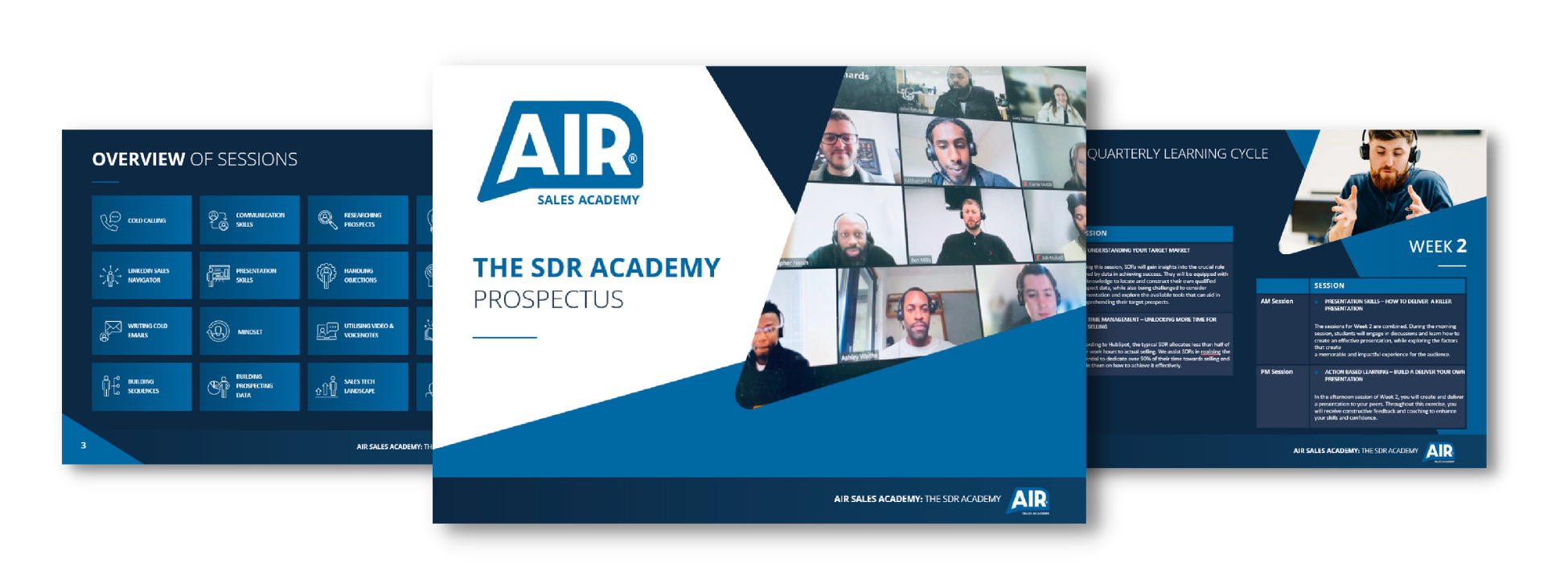
The SDR Academy’s unique offering involves both learning new things as well as topping up and refreshing existing knowledge. We hold SDRs accountable for what they’ve learnt with regular sessions every single week. It’s the best of both worlds – a continuous learning journey combined with external expertise and learning from other people with different experiences.

We believe that sales training doesn’t have a beginning and end. You don’t have one session on ‘objection handling’ and then handle every instance perfectly. You don’t attend a session on ‘writing cold emails’ and then compose winning emails every time. You never complete your learning around sales. It’s an evolution; a process of continuous improvement.

The SDR Academy is an ongoing subscription to virtual training sessions. Run in live, virtual rooms, the courses are created and facilitated by leading industry experts. It’s comprehensive, affordable and impactful.

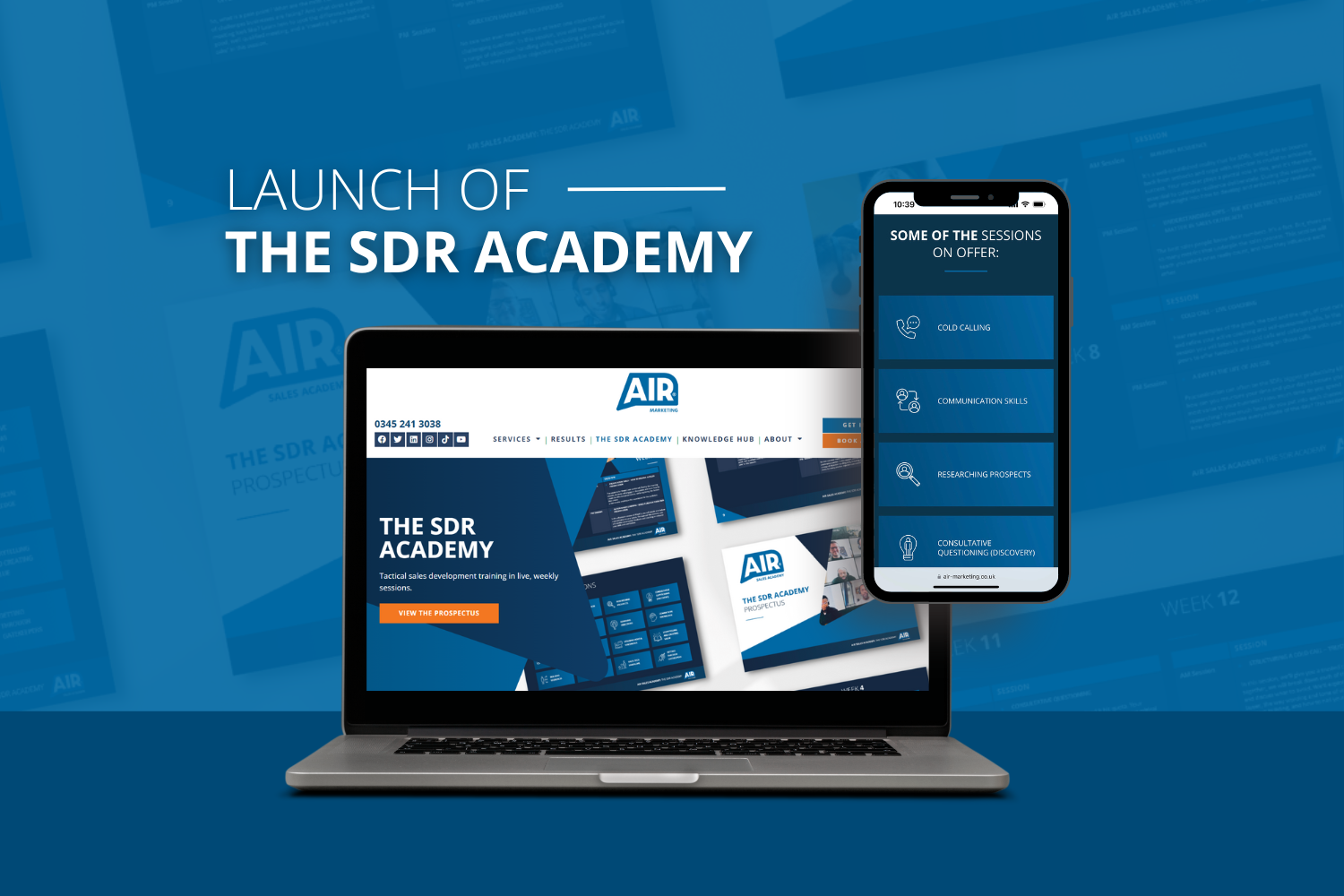
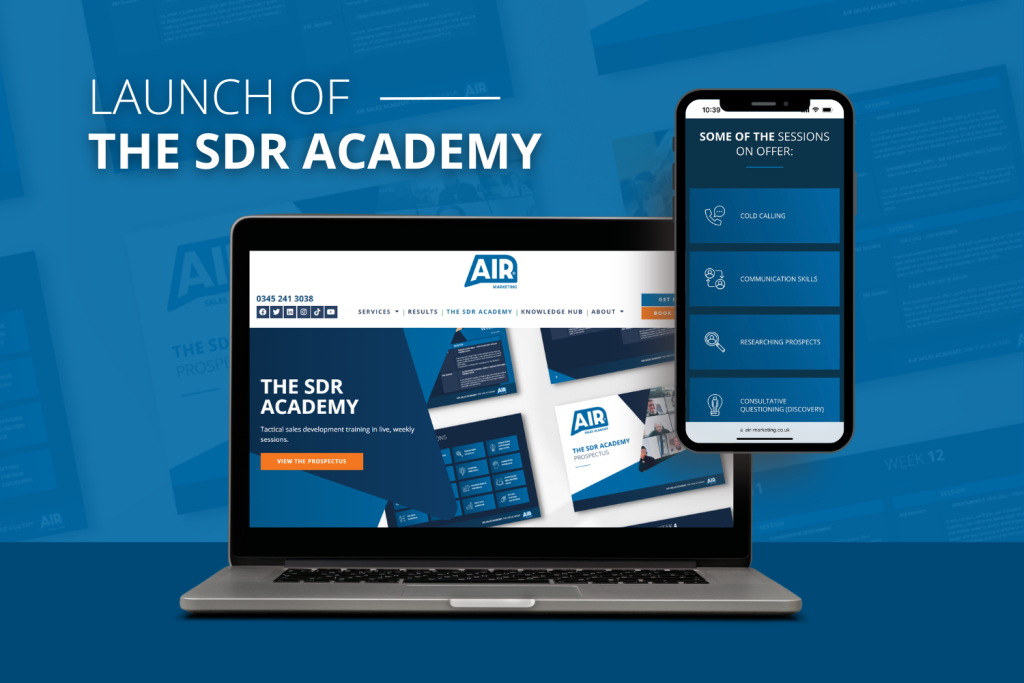
Launch of The SDR Academy by Air Sales Academy

We are delighted to announce our further expansion with the launch of  The SDR Academy by Air Sales Academy – a virtual sales training academy to help businesses upskill their sales teams.

The SDR Academy is designed to help businesses across the UK, train Sales Development Representatives (SDRs) in skills including cold calling, social selling, email writing, and objection handling. All sessions are live and interactive, allowing delegates to ask questions as they learn.

Delivering the live sessions will be trainers like Erik Pollitt, a Sales Trainer & Consultant with over fifteen years of experience (including as Learning & Performance Manager at ao.com), Owen Richards (Air’s Founder & CEO) and James Ski (Founder of Sales Confidence).

Erik said: “Many businesses want to create a comprehensive training package for sales staff but don’t have the time, money, or experience. This is where Air’s Sales Academy comes into its own. With over 100 sessions on offer, delegates can attend as many or as few sessions as they want, whether they’re working from home or the office.

We offer an ongoing training solution. One that sees your sales reps experience industry leading training sessions every week. And with a cost of as little as £15 per person per session, companies will see a fantastic return on their investment.”

Owen Richards, Founder & CEO of Air Marketing, continued: “We’ve been providing sales support to companies across the country for several years, employing and training SDRs. As a part of that journey we have built a best-in-class training academy internally, and it makes sense to open that experience up to other organisations. We’re perfectly placed to offer relevant, innovative, and effective SDR training, and help other companies get the most out of their investment in sales roles.

It’s been exciting pulling all of the content together and now we’re able to offer this brand-new service to businesses that want to improve their sales results and see tangible results. I’m just looking forward to getting started.”

To find out more about The SDR Academy, visit the website here, or call our team on 0345 241 3038.